What Happens If a Molar Is Missing?
Lesson 13 · Structural Decision Framework
In plain English
We see this all the time: a patient lost a back tooth five years ago. "Just one tooth, way in the back, no big deal." They never replaced it.
Today, on the X-ray, the tooth in front of the gap has tipped backward into the empty space. The molar above it on the opposite jaw has drifted down, looking for something to bite against. The bite that was symmetric five years ago isn't anymore. And the patient's been chewing on the other side without realizing it.
A missing tooth isn't just a gap. It's a force redistribution.
Here's the part most patients don't think about:
When all your teeth are there, chewing force is shared across the whole row. When one is missing, especially a back molar, which absorbs more force than any other tooth, the force has to go somewhere. It moves to:
1. The tooth in front of the gap (which leans into the space).
2. The tooth on the opposite jaw (which drifts looking for a bite partner).
3. The teeth across the bite that are now compensating for the missing one.
Those teeth now take more load than they were designed to handle. Over years, that shows up as accelerated wear on the cusps, hairline cracks, and slow tipping or migration.
None of it is sudden. None of it hurts when it starts. But each year the redistribution runs, the teeth doing the extra work move further from how they were originally designed. Replacing a missing tooth, with an implant, bridge, or partial, isn't just cosmetic. It's putting force back where it belongs.
The gap is the obvious part. The redistribution is the part that decides what happens next.
The Lesson
One idea. One lesson.
Every idea in the Structural Decision Framework gets its own lesson. Hover to feel the foil.
SDF-13
ForceWhat Happens If a Molar Is Missing?
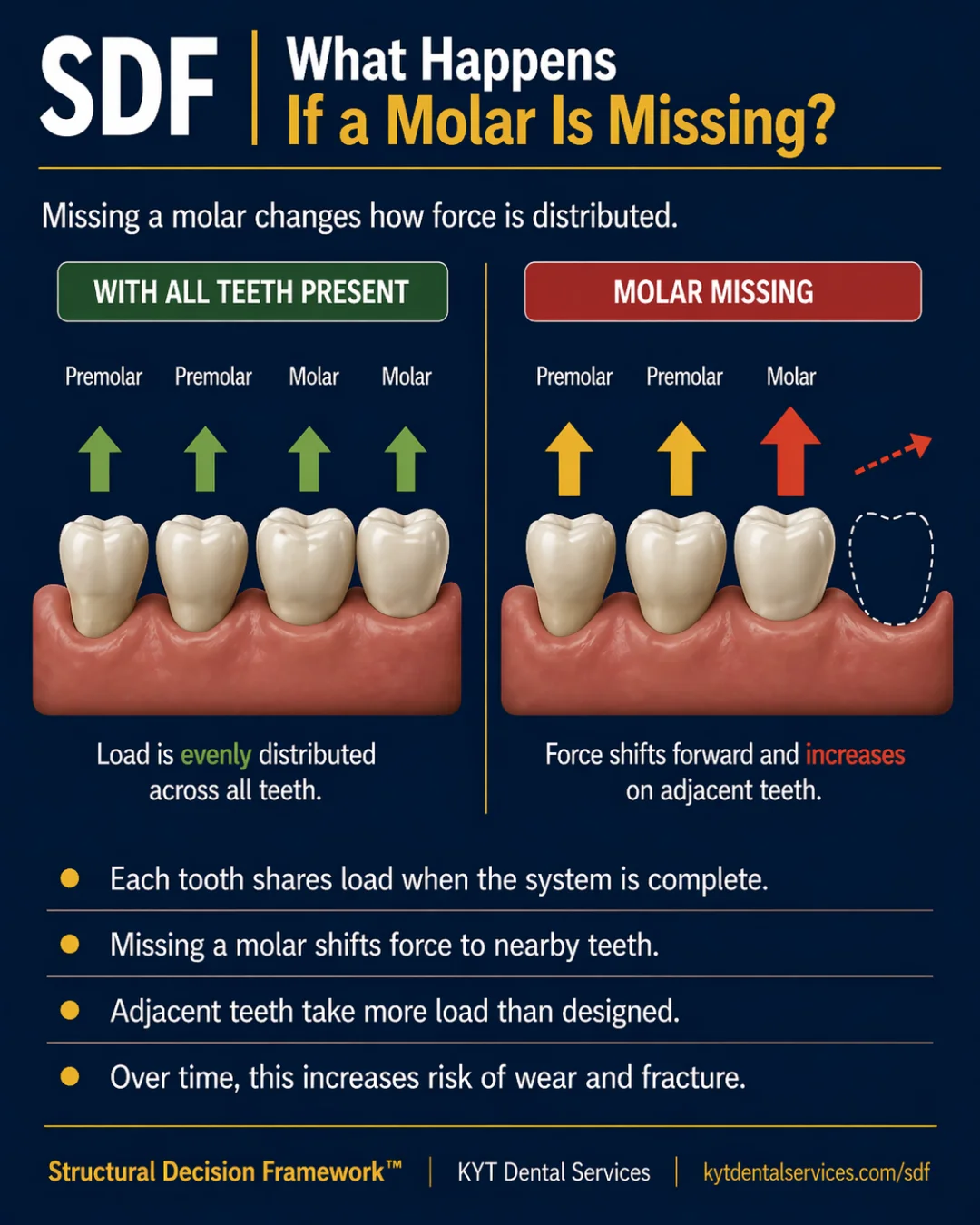
A missing molar isn't just a gap, it's a force redistribution. The teeth that are still there start doing more work than they were designed to.
↓ Open the model
Inside the Model
Read the diagram.
Through the Force lens, the bite isn't a row of teeth, it's a system that distributes load. What Happens If a Molar Is Missing is the card that shows the system working both ways: with all the parts present, force flows evenly. With a part missing, the same force has to go somewhere, and that somewhere is usually a tooth that wasn't designed for it.
Fig. 13 · What Happens If a Molar Is Missing?
SDF Framework
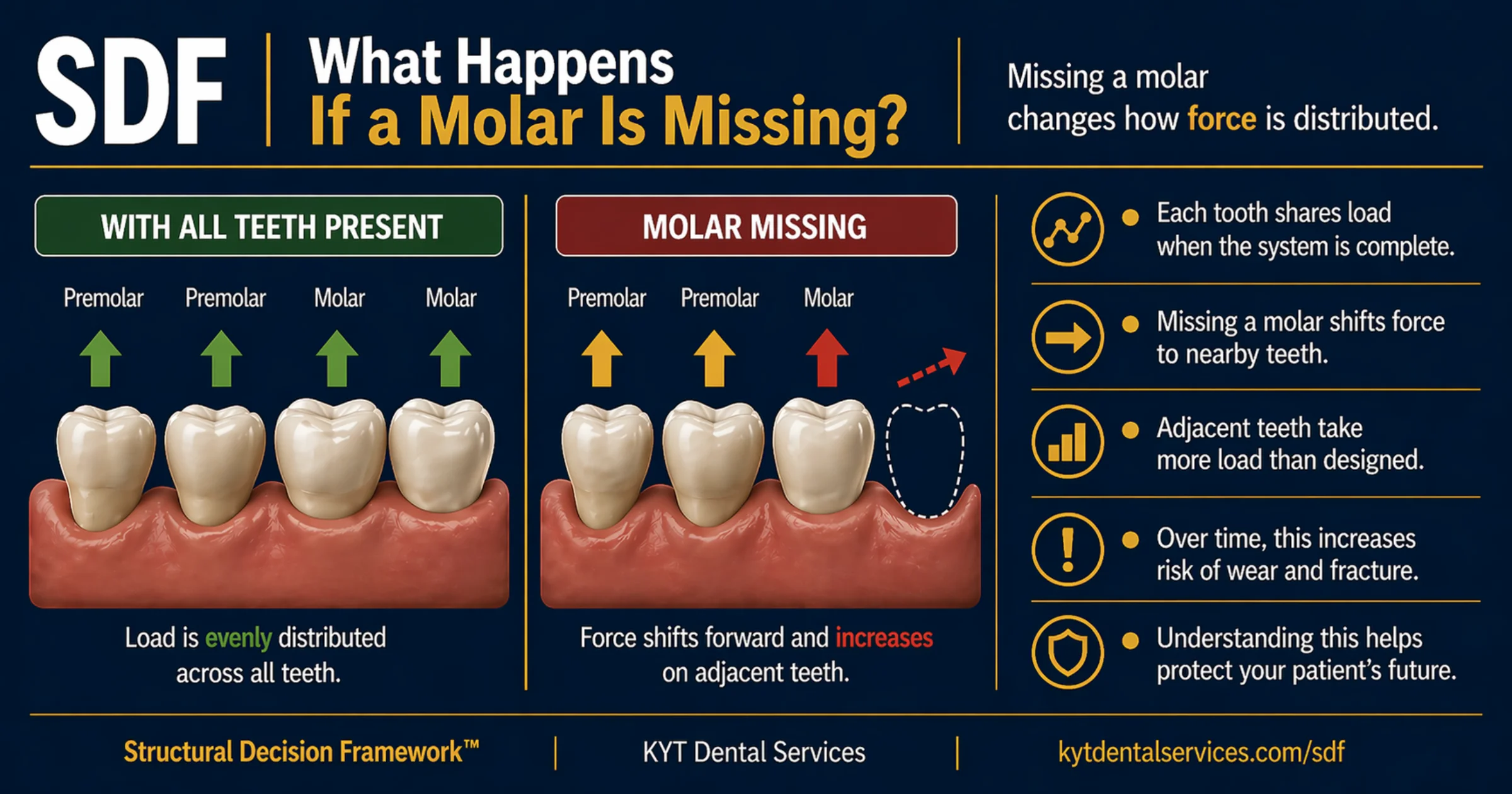
Your bite is a system. When all the teeth are there, chewing force is shared across the whole row. When one is missing, especially a back molar, the force has to go somewhere, and it moves to the teeth next to and opposite the gap. Those teeth now take more load than they were built for. The gap itself is the obvious part; the slow rise in force on the rest of the mouth is the part that decides what happens next.
Explanation
It's easy to look at a missing molar and only see what's gone. The structural reality is what's left over: the teeth that are still there are now carrying the force that used to be spread across one more tooth. The neighbors next to the gap absorb extra force from leaning in. The teeth on the opposite jaw get less support and can drift up or down without anything to bite against. Over the years, this shows up as accelerated wear on the cusps, hairline cracks in the teeth picking up the extra load, and slow tipping or migration of the teeth around the gap. None of that is sudden. None of it hurts when it starts. But each year the redistribution runs, the teeth doing the extra work move further from the way they were originally designed. That's why replacing a missing tooth, with an implant, bridge, or partial, isn't just cosmetic. It's a way of putting force back where it belongs.
Key takeaways
- Each tooth shares the load when the system is complete.
- Missing a molar shifts force to the teeth next to it and opposite to it.
- The neighbors take more load than they were designed to handle.
- Over years, this raises the risk of wear, cracks, and drift in surrounding teeth.
- Replacing a missing tooth is mostly about restoring how force is distributed, not just filling the gap.
In the chair
How it shows up.
01
The slow tilt
A patient lost a lower molar five years ago and never replaced it. The tooth in front has slowly tipped backward into the space, and the molar above on the opposite jaw has drifted down looking for something to bite against. The X-ray now looks very different from the day the tooth was extracted, and any future restoration has to work around the migration that's already happened.
02
The cracked neighbor
A patient comes in with pain on the tooth right in front of an old extraction site. Examination reveals a crack along the cusp facing the gap. The cause isn't decay, it's force. That tooth has been absorbing load it wasn't designed for, and after enough years, it cracked. The lost molar didn't fail; the tooth taking its place in the load chain did.
03
The decision to replace
A patient is weighing whether to replace a missing molar. From a Force lens, the question isn't whether the gap is bothering them, it's whether the rest of the mouth has been handling the redistribution well. If wear is rising, if the neighbors are stressed, if the opposite tooth has drifted, replacement is structural maintenance. If everything around it has stayed stable, the decision is more about cosmetics and chewing efficiency.
Through other lenses
The same idea, three other ways.
The whole card is about force redistribution. A missing tooth doesn't reduce the force in your bite, it concentrates it on the teeth that are still there. Restoring the missing tooth is how you restore the load distribution.
The teeth taking the extra load lose structure faster, through wear, cracks, and the restorations they end up needing. A missing molar is one of the slowest, quietest ways to accelerate structural loss in nearby teeth.
Time is what turns a redistribution into a problem. The first year after losing a molar, very little changes. Five years in, drift, wear, and cracks have accumulated. The longer the gap stays, the harder it is to put the force back where it was.
Common questions
FAQ.
Is one missing molar really a big deal?+
On its own, today, no, nothing acute happens. Over years, yes. A missing molar slowly redistributes chewing force onto teeth that weren't designed for it, and that shift is what raises the risk of wear, cracks, and drift in the surrounding teeth. The damage is gradual, which is why it often goes unnoticed until something else fails.
Do I need to replace it if it's not bothering me?+
Not bothering you doesn't mean nothing is happening. The redistribution is silent. Whether to replace it depends on how the rest of the mouth is responding, if wear, drift, or cracks are showing up nearby, replacement is structural maintenance. If everything around it has stayed stable, the decision is more about chewing efficiency and aesthetics.
Will the teeth around the gap really move?+
Often, yes. The tooth in front of a gap can tip backward into the space, and the tooth on the opposite jaw can drift down or up because there's nothing biting against it. The movement is slow and may not be visible to you, but it shows up clearly on X-rays over time.
What are the options for replacing a molar?+
The main three are an implant (a titanium root with a crown on top), a bridge (a fake tooth supported by the teeth on either side), or a partial denture. Each has tradeoffs in cost, longevity, and how much it does to restore the original force distribution. Implants come closest to mimicking the original tooth structurally.
Is it ever fine to leave a missing tooth alone?+
Sometimes, particularly if the missing tooth is a wisdom tooth or a tooth at the very back of the row with no opposite to bite against. In those cases, the force redistribution effect is much smaller. For first or second molars in the middle of an active bite, leaving the gap is structurally riskier.
See this lesson in a real case
Stories behind this lesson.
Patient cases where this idea showed up in the chair.
See it in real teeth
From idea to actual cases.
This site explains the idea. The clinical version, with real cases, real X-rays, and what this looks like in actual mouths, lives at KYT Dental Services, the practice this framework comes from.
See it on KYT Dental Services →Keep going