How Teeth Actually Fail
Lesson 02 · Structural Decision Framework
In plain English
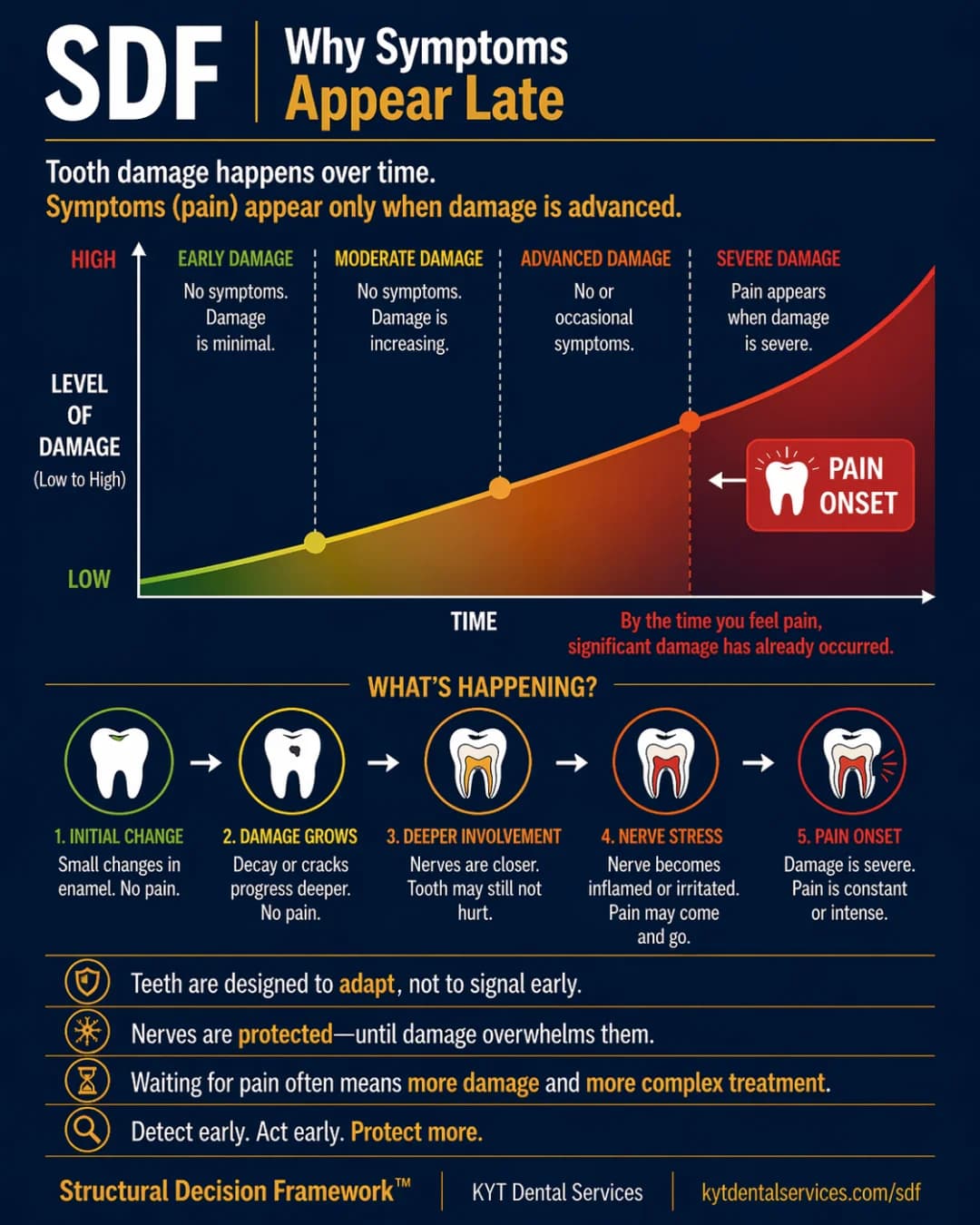
We see this all the time: a patient bites into a piece of toast, and a back molar splits.
They're stunned. "It was just toast."
Here's what they couldn't see. That tooth had three big old fillings under the surface. Years of nighttime grinding. A worn-down chewing surface they'd never thought twice about. The toast didn't break the tooth. The toast was just the last withdrawal from an account that had been running on fumes for years.
The bite that breaks a tooth is almost never the cause. It's the last event in a long process, bites, grinding, old fillings, missing support, adding up quietly until one normal day finally crosses the line.
This is the part most patients don't see:
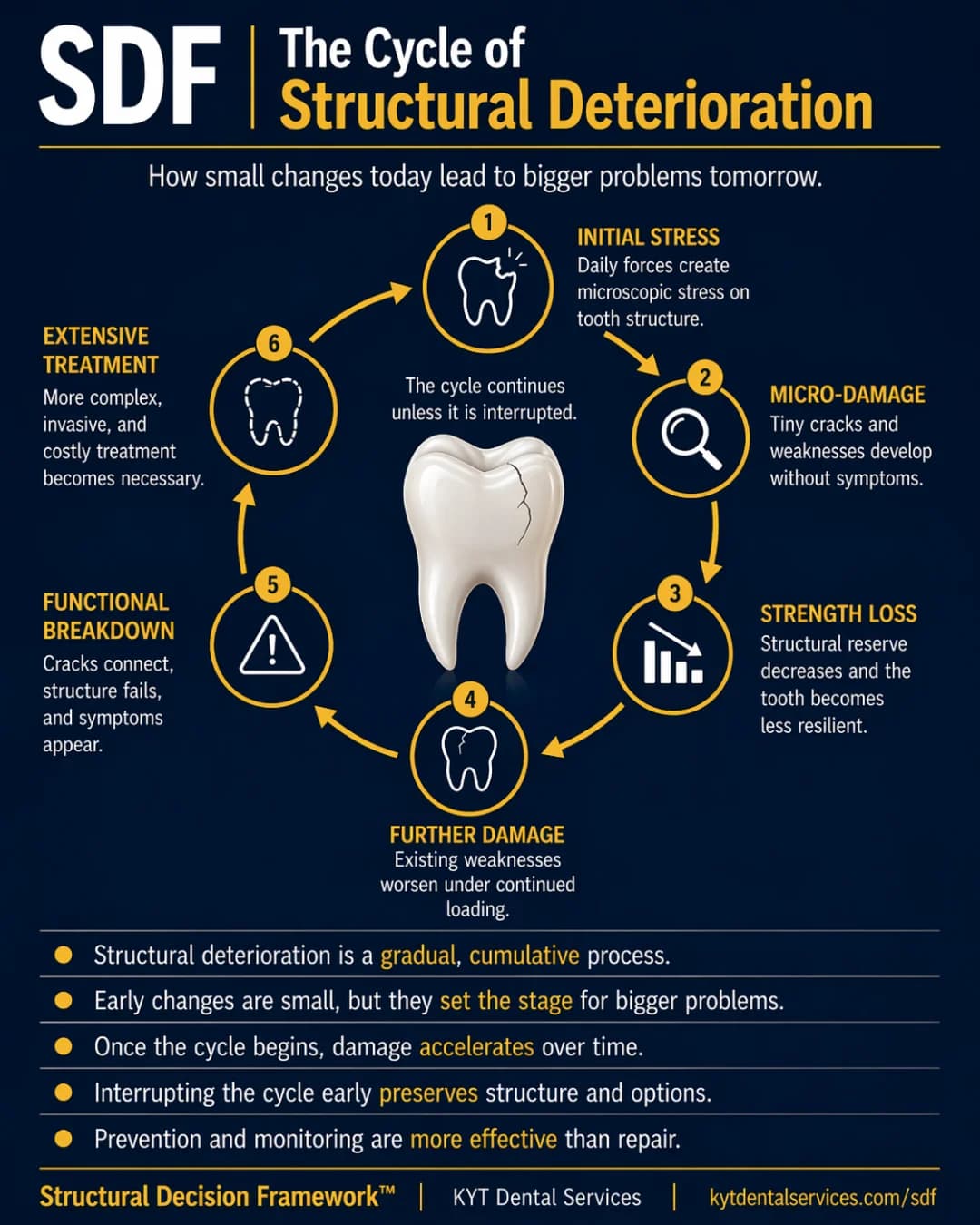
Damage doesn't reset between events. It stacks. Every chew, every grind, every microscopic stress leaves a tiny bit of fatigue that the tooth carries forward into the next bite. The tooth absorbs it. Until it can't.
That's why the most useful question in dentistry isn't "is this tooth broken?" It's "where on the curve is this tooth right now, and what does the next event do to it?" Most catastrophic fractures had small warning signs months, sometimes years, before they happened. Sensitivity that comes and goes. Soreness when chewing certain foods. A tooth that just feels different than it used to.
The fracture is the end of the process. The signs are the middle. The fix is almost always cheapest in the middle.
If you've ever had a tooth break "out of nowhere", it didn't. Nowhere is just the part you couldn't see.
The Lesson
One idea. One lesson.
Every idea in the Structural Decision Framework gets its own lesson. Hover to feel the foil.
SDF-02
TimeHow Teeth Actually Fail
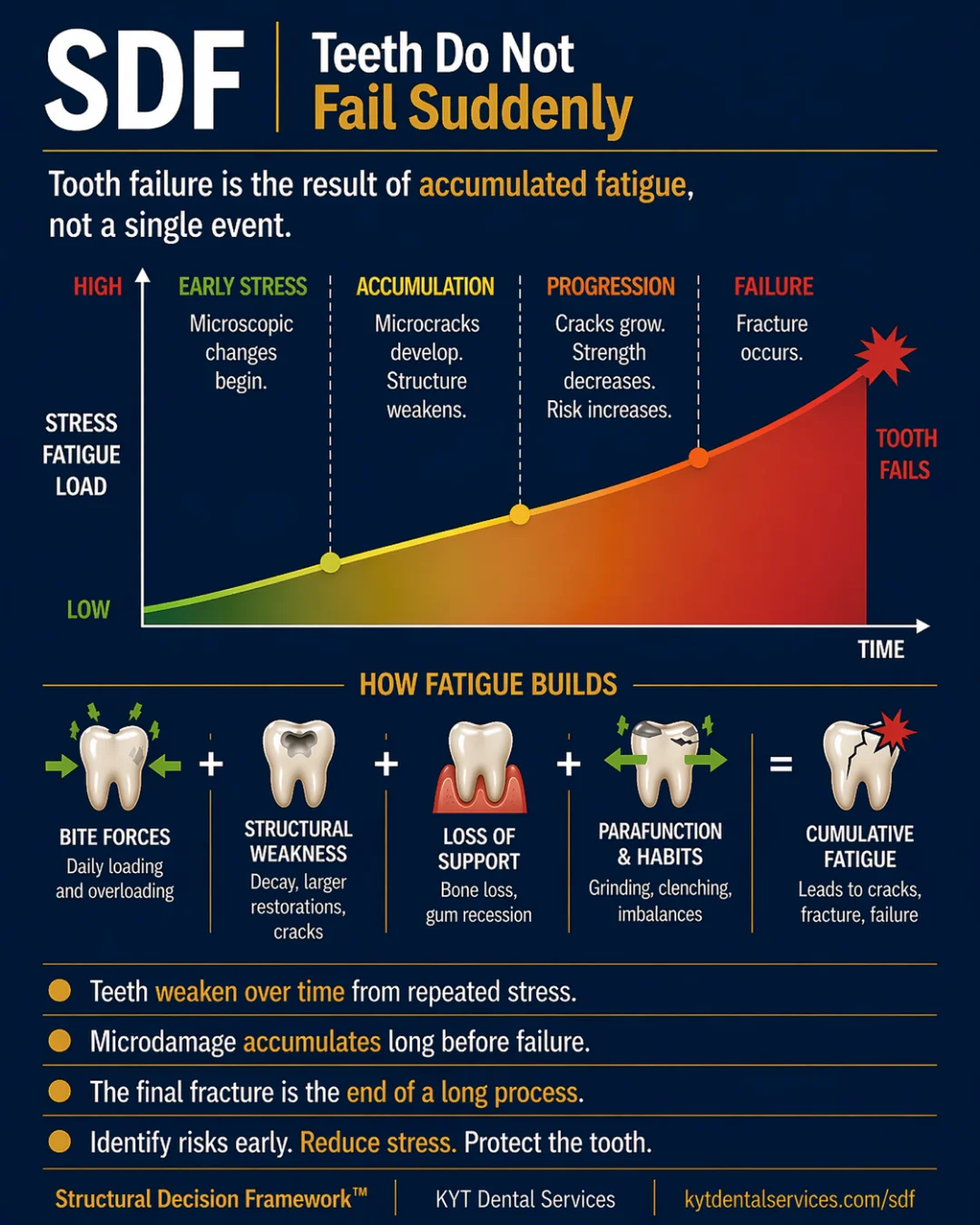
Teeth don't break in a single moment. They fail at the end of a long process.
↓ Open the model
Inside the Model
Read the diagram.
Looking through the Time lens, no fracture is really sudden, even when it feels that way. Each bite, each grind, each year of wear leaves a tiny bit of damage that doesn't reset. The tooth absorbs it, until one day it can't. How Teeth Actually Fail is the card that asks: where on the curve is this tooth right now, and what's the next event going to do?
Fig. 02 · How Teeth Actually Fail
SDF Framework
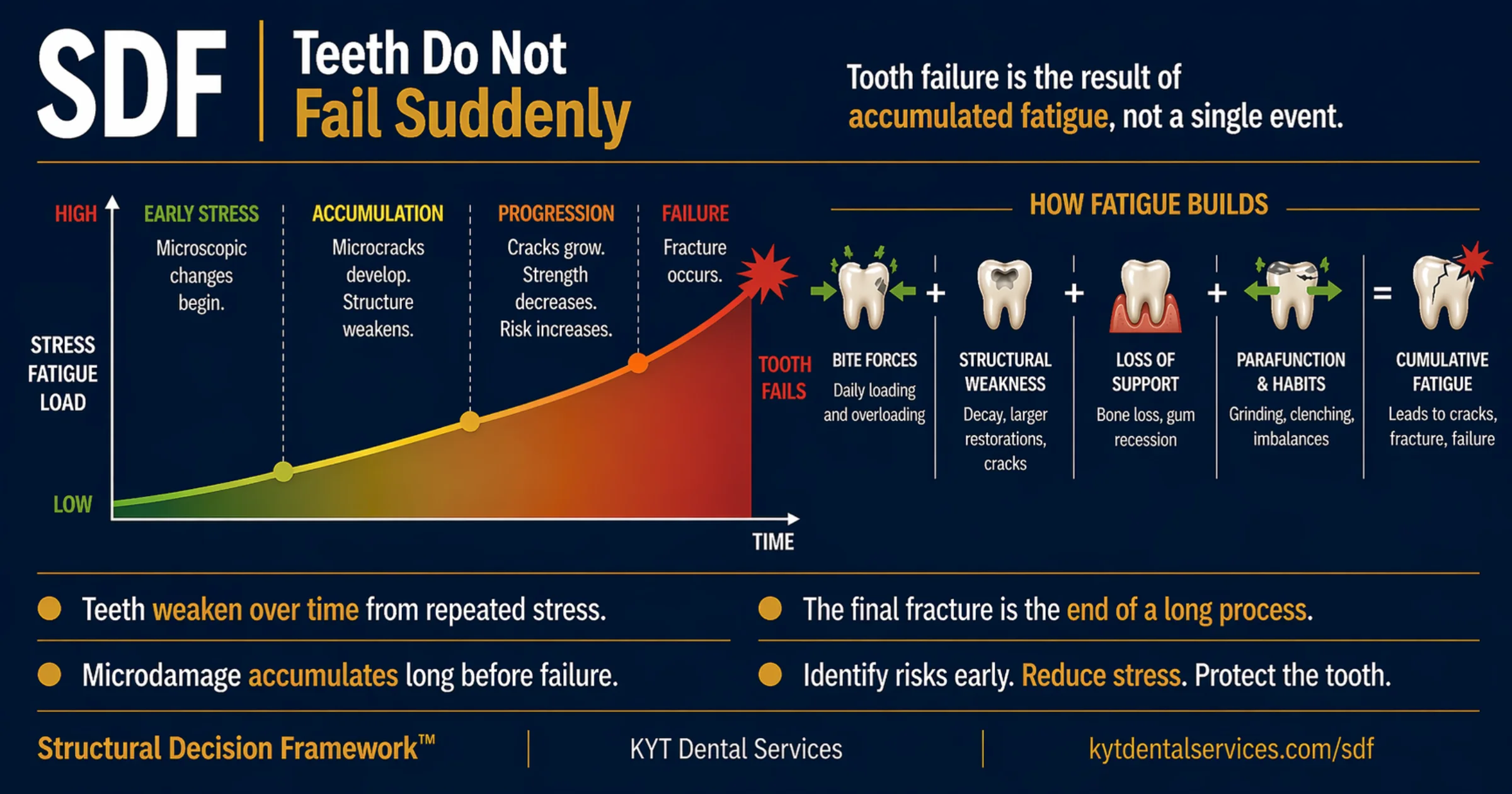
Teeth don't shatter for no reason. They fail at the end of a long process, small stresses adding up, year after year, until the next normal bite is the one that breaks something.
Explanation
Repeated bite force, grinding, old fillings, and missing support each add a tiny amount of stress. The tooth handles each one. But the damage doesn't reset between events, it stacks. The actual fracture is just the moment the load finally exceeds what the tooth can absorb.
Key takeaways
- The fracture is the end of a long process, not the start.
- Small stresses add up. Each one matters more than it looks.
- Catching the pattern early is the only way to stop the ending.
In the chair
How it shows up.
01
The bite that finally cracks the molar
You bite into a piece of toast. The tooth cracks. The toast didn't cause the failure, fifteen years of grinding, three big fillings, and one old crown did. The toast was just the last withdrawal from an account that was already empty.
02
The microcrack you don't feel
A tiny crack runs through a tooth. No pain, no bleeding, no symptom. You have no idea it's there. It started years ago and grows a little with each chew. The tooth is already failing, just slowly enough that nobody's noticed yet.
03
The patient who 'never had problems'
Mid-50s, always taken care of their teeth. Then four molars need work in two years. It looks sudden. It isn't. Decades of normal use accumulated to the same point at roughly the same time. The wave was always coming.
Through other lenses
The same idea, three other ways.
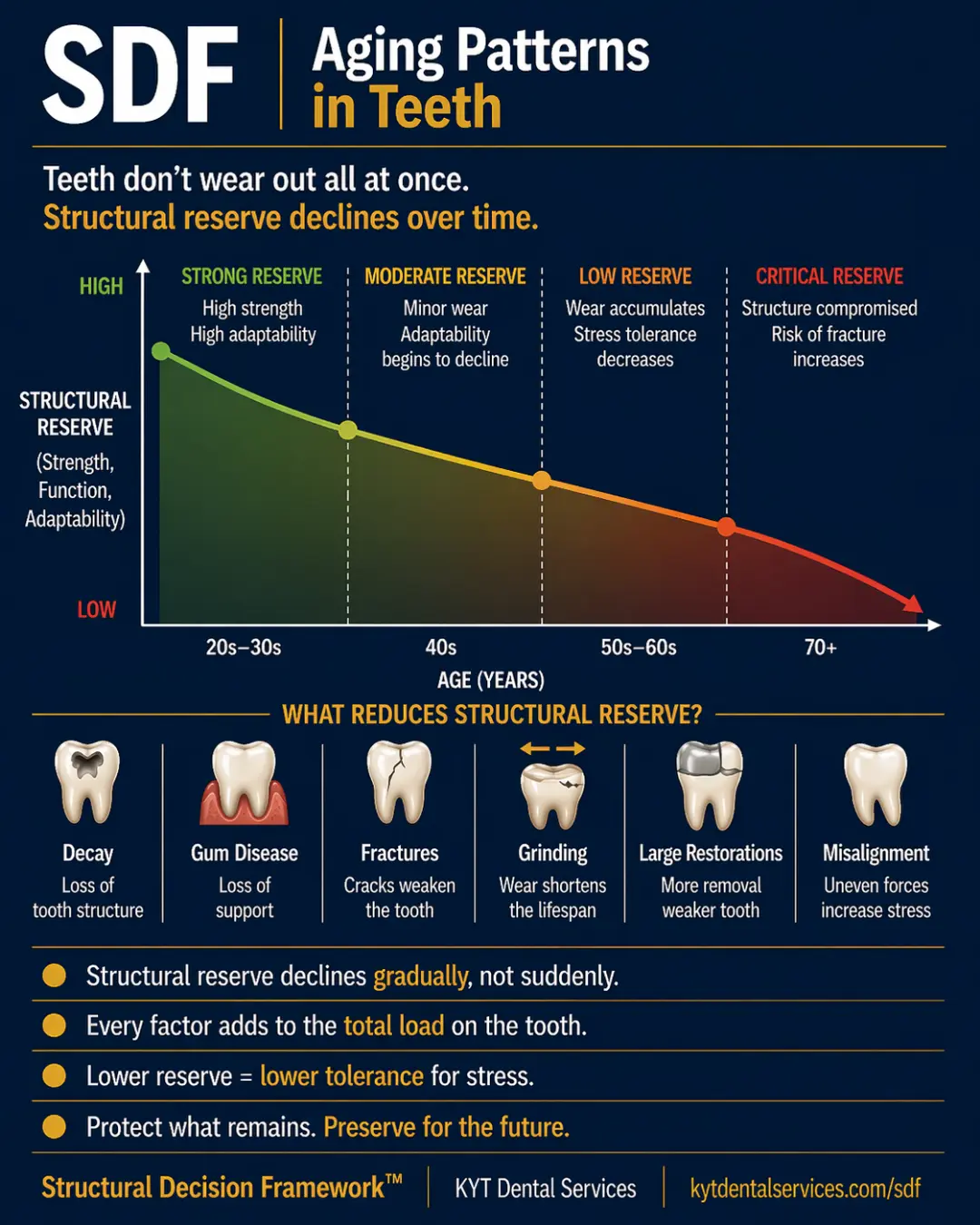
Each event leaves the tooth with a little less to work with. Reserve and fatigue are two sides of the same withdrawal, what gets taken from one is what builds in the other.
The forces don't have to be heavy. Small repeated stresses do more damage over time than a single big impact, because the tooth never gets to fully recover between cycles.
The treatment that lasts is the one that breaks the cycle, reducing the stress, supporting weak structure, or replacing what can't be saved before the next event lands.
Common questions
FAQ.
Why do teeth seem to break out of nowhere?+
Because the failure point is invisible. The damage builds up slowly inside the tooth, and the only event that's visible is the last one, the bite that crosses the line. Everything before it looked fine.
Can I tell my tooth is failing before it breaks?+
Sometimes. Sensitivity to cold, soreness when chewing, a small visible crack, or a tooth that just 'feels different' are all early signals. Often there are none, which is why dentists check teeth that look normal, they're looking for damage before it surfaces.
Does this mean every old tooth is going to fail?+
No. It means every tooth is on a curve. Some teeth are far from the failure point and need nothing. Some are close and need attention. The point is to know which is which, not to assume the worst.
Is grinding really that bad?+
Yes. Grinding multiplies the daily stress on a tooth by orders of magnitude. A grinder's tooth ages closer to twice as fast as a non-grinder's. A nightguard is one of the few things that genuinely slows the curve.
What should I do if a tooth feels different?+
Get it checked, even if there's no pain. Most catastrophic fractures show small warning signs months or years before they happen, sensitivity to cold, soreness when biting, a tooth that feels weird. Acting on those is much cheaper than acting on a fracture.
See it in real teeth
From idea to actual cases.
This site explains the idea. The clinical version, with real cases, real X-rays, and what this looks like in actual mouths, lives at KYT Dental Services, the practice this framework comes from.
See it on KYT Dental Services →Keep going