Forces That Shape Tooth Stability
Lesson 06 · Structural Decision Framework
In plain English
We see this all the time: a patient with no cavities, great hygiene, comes in with thinning enamel and sensitive teeth, and they have no idea why.
When we ask about their day, the answer is usually some version of "I sip diet soda or sparkling water through the afternoon." There's no sugar in either of those. Cavity risk is low. But the enamel didn't get thin from sugar, it got thin from acid. And acid does damage that brushing can't undo.
Here's the part most people don't think about:
Bite force isn't the only thing pressing on your teeth. There are five major forces working on every tooth in your mouth, every day:
1. Vertical bite force from chewing.
2. Side-to-side force from chewing and grinding.
3. Temperature swings, hot coffee plus cold water makes enamel expand and contract.
4. Acid from food, drinks, and stomach reflux.
5. The sheer number of small loading cycles your teeth absorb across thousands of bites a day.
Each one is small on its own. None of them break a tooth in a single hit. But the mix of all five, over years, is what decides how long your teeth last. The damage profile depends on which force is dominant in your mouth. A grinder's teeth show wear. A diet-soda sipper's teeth show acid erosion. A hot-and-cold drinker accumulates micro-cracks. Same forces. Different teeth.
This is why "why am I getting cavities, I brush twice a day" rarely has a single answer. The right question is which of the five forces is loudest for you, and what would reduce it.
The Lesson
One idea. One lesson.
Every idea in the Structural Decision Framework gets its own lesson. Hover to feel the foil.
SDF-06
ForceForces That Shape Tooth Stability
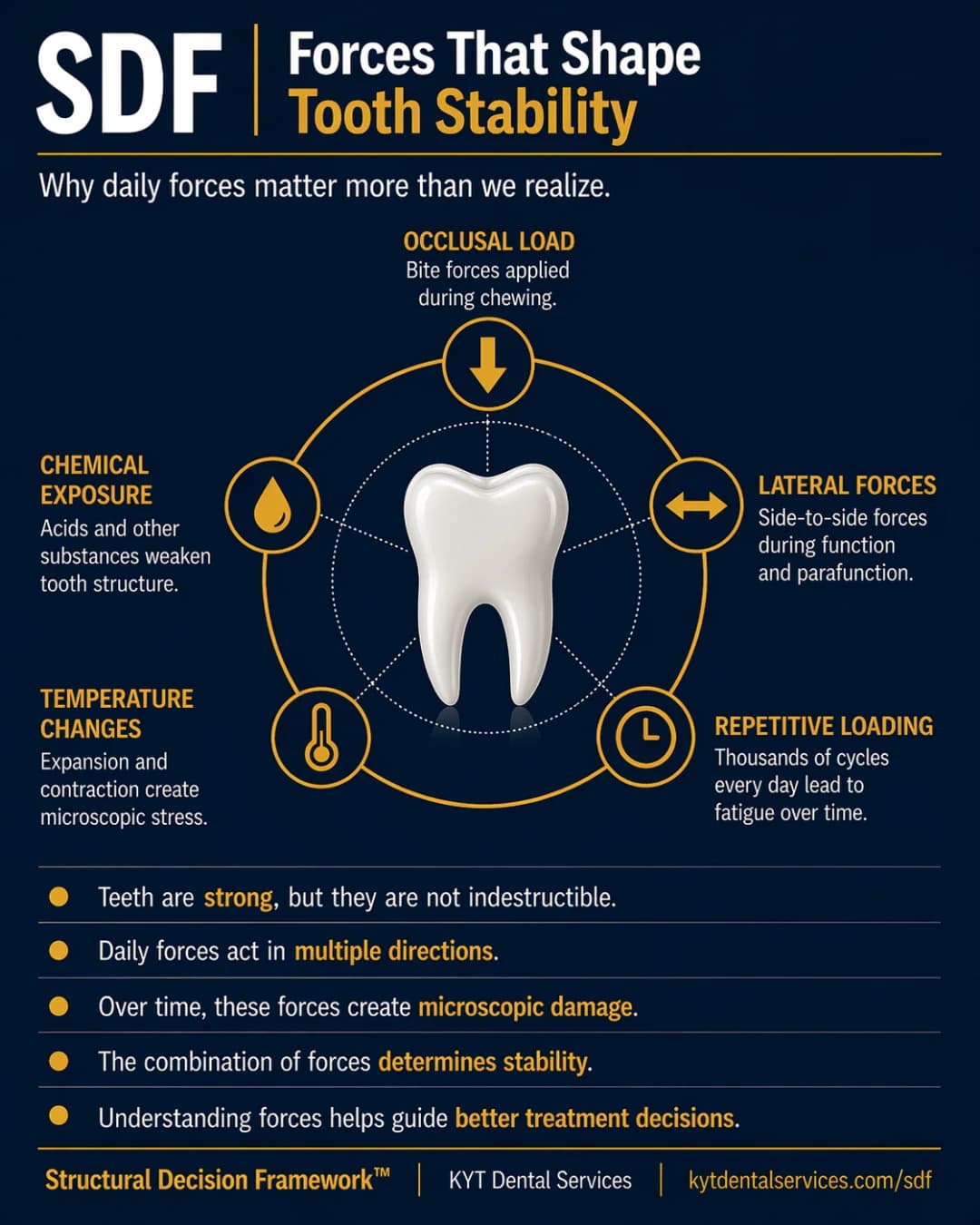
Your teeth handle dozens of forces every day. The mix of all of them, not any single one, is what shapes how long they last.
↓ Open the model
Inside the Model
Read the diagram.
Through the Force lens, every tooth is being pushed on from multiple angles every day, bite force from chewing, side-to-side force from grinding, expansion from temperature, chemical wear from acid, repetition from thousands of small cycles. Forces That Shape Tooth Stability is the card that names them all and asks: which of these is doing the most damage to this tooth?
Fig. 06 · Forces That Shape Tooth Stability
SDF Framework
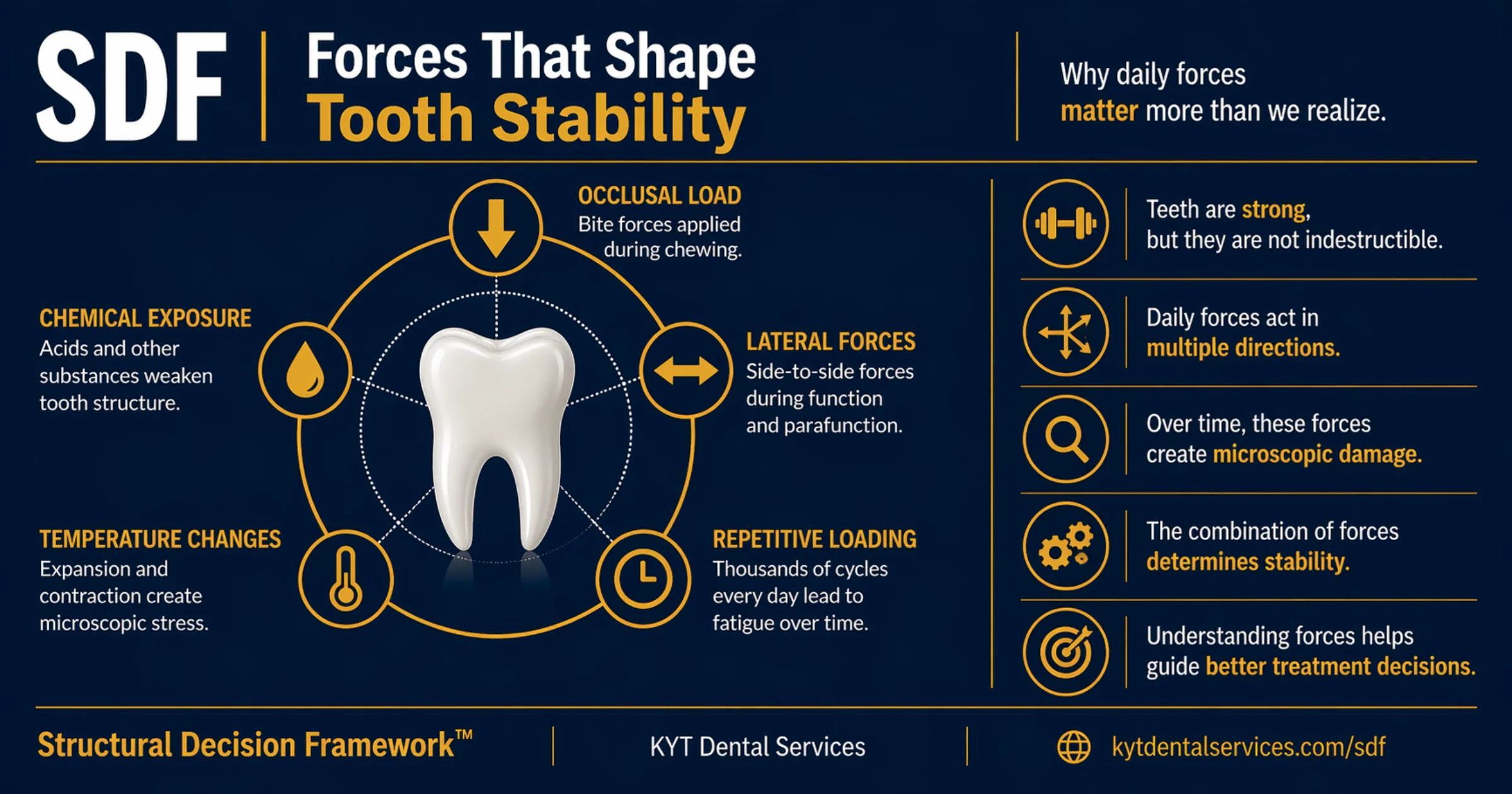
Bite force isn't the only thing pressing on your teeth. Every chew, every temperature swing, every acidic drink, every grinding cycle adds another layer of stress. Each one is small. Together, they're what determines how long a tooth holds up.
Explanation
Most people picture chewing as the only stress on a tooth. It's actually one of five, and the others matter just as much over time. Side-to-side forces from chewing and grinding flex the tooth. Hot coffee followed by cold water makes the enamel expand and contract. Acid from soda or stomach reflux softens the surface. Thousands of small loading cycles every day cause fatigue, even if no single bite is too hard. The tooth's stability is the sum of how all these forces stack up.
Key takeaways
- Teeth are strong, but they're not indestructible.
- Daily forces don't come from one direction, they come from many.
- Small forces add up. Most damage is the result of repetition, not impact.
- It's the combination of all the forces, not any single one, that shapes how a tooth holds up.
- Knowing what forces are acting on a tooth is what makes treatment decisions smart, not generic.
In the chair
How it shows up.
01
The grinder with no obvious damage
You grind your teeth at night. No pain, no chips, nothing visible. But every night your teeth are flexing under hundreds of pounds of side-to-side force. After ten or twenty years, that side-load shows up as worn-down chewing surfaces, hairline cracks, or a tooth that suddenly fractures. The grinding wasn't doing nothing, it was just doing damage on a slow timer.
02
The cold-and-hot drinker
You drink iced coffee with hot toast every morning. Each swing in temperature makes enamel expand and contract very slightly. On its own, that's nothing. Compounded over years, it contributes to tiny cracks. Combined with grinding or acidic foods, it accelerates wear that wouldn't have shown up otherwise.
03
The diet soda habit
Diet soda has no sugar, so cavity risk seems low. But it's acidic, and acid softens enamel before bacteria ever get involved. Sip it through the day and the enamel stays soft for hours. The chemical force quietly does what bite force can't.
Through other lenses
The same idea, three other ways.
Each force takes a different toll on the layers. Bite force compresses enamel. Lateral force flexes dentin. Acid dissolves enamel. The damage profile depends on which force is dominant for your mouth.
Force damage is cumulative. A bite that's fine once is a problem ten thousand times. Most force-driven damage shows up gradually, which is why it's invisible until it isn't.
The most stable treatment plan accounts for all the forces, not just the loudest one. Fixing a chewing surface but ignoring nighttime grinding sets the next problem in motion.
Common questions
FAQ.
What's actually pressing on my teeth besides chewing?+
Five main forces: vertical bite force when you chew; side-to-side force during chewing or grinding; temperature-driven expansion and contraction; acid eroding enamel; and the sheer number of small cycles per day. Each is small individually; together they decide how a tooth holds up over decades.
If I don't grind, do lateral forces still affect me?+
Yes, just less aggressively. Even normal chewing produces some side-to-side force, especially on uneven bites or teeth with previous restorations. Grinders multiply this force, but no one is at zero.
Are some teeth under more force than others?+
Definitely. Back molars handle the most chewing force. Front teeth handle more side-to-side force from biting. Teeth with large existing fillings absorb more flex per bite because they have less natural structure to distribute it. The risk profile for each tooth in your mouth is different.
Can I do anything about temperature or acid forces?+
Yes. A water rinse after acidic drinks neutralizes the surface. Avoiding extreme hot-then-cold cycles helps. A nightguard handles grinding. None of these eliminate force entirely, but reducing the loudest one for your mouth makes a measurable difference over time.
Why does my dentist ask about diet, grinding, and habits?+
Because those questions are how they figure out which forces are doing the most work in your mouth. The same cavity in two patients can have totally different causes, and the right treatment depends on which force is driving it.
See this lesson in a real case
The story behind this lesson.
A patient case where this idea showed up in the chair.
See it in real teeth
From idea to actual cases.
This site explains the idea. The clinical version, with real cases, real X-rays, and what this looks like in actual mouths, lives at KYT Dental Services, the practice this framework comes from.
See it on KYT Dental Services →Keep going