Crown vs Root Canal: What Changes Structurally?
Lesson 12 · Structural Decision Framework
In plain English
We see this all the time: two patients with cavities very close to the nerve. One walks out with a crown only. The other walks out with a root canal AND a crown. Both teeth get "saved." The structural cost is very different.
Here's what most patients don't realize:
A crown and a root canal both fix a tooth, but they don't change it the same way.
A crown shaves a thin layer off the OUTSIDE of the tooth, about a millimeter, to make room for the cap. The bulk of the natural tooth, especially the dentin core that gives it strength, stays. The crown wraps the structure that's still there.
A root canal opens the tooth from the top and removes the pulp, then shapes the canals, which means removing dentin from the chamber down through the roots. The tooth still functions. But the geometry is hollowed out. Less internal structure means less resistance to fracture under chewing force, which is why root canal teeth almost always need a crown afterward anyway.
So when both teeth get "saved," they don't end up the same shape:
Crown only: outer layer reduced, internal structure intact, full strength wrapped.
Root canal + crown: outer layer reduced, internal structure hollowed out, then wrapped.
Same outcome on paper. Different geometry underneath. The crown-only tooth lasts longer, on average. The root-canal-plus-crown tooth still works, but the structural cost is permanent.
This isn't an argument against root canals. They save teeth that would otherwise be extracted. It's the reason for catching things earlier, while a crown alone is still enough. The patient who came in six months sooner often gets the crown-only path. The same tooth six months later is the one that needed both.
The Lesson
One idea. One lesson.
Every idea in the Structural Decision Framework gets its own lesson. Hover to feel the foil.
SDF-12
StructureCrown vs Root Canal: What Changes Structurally?
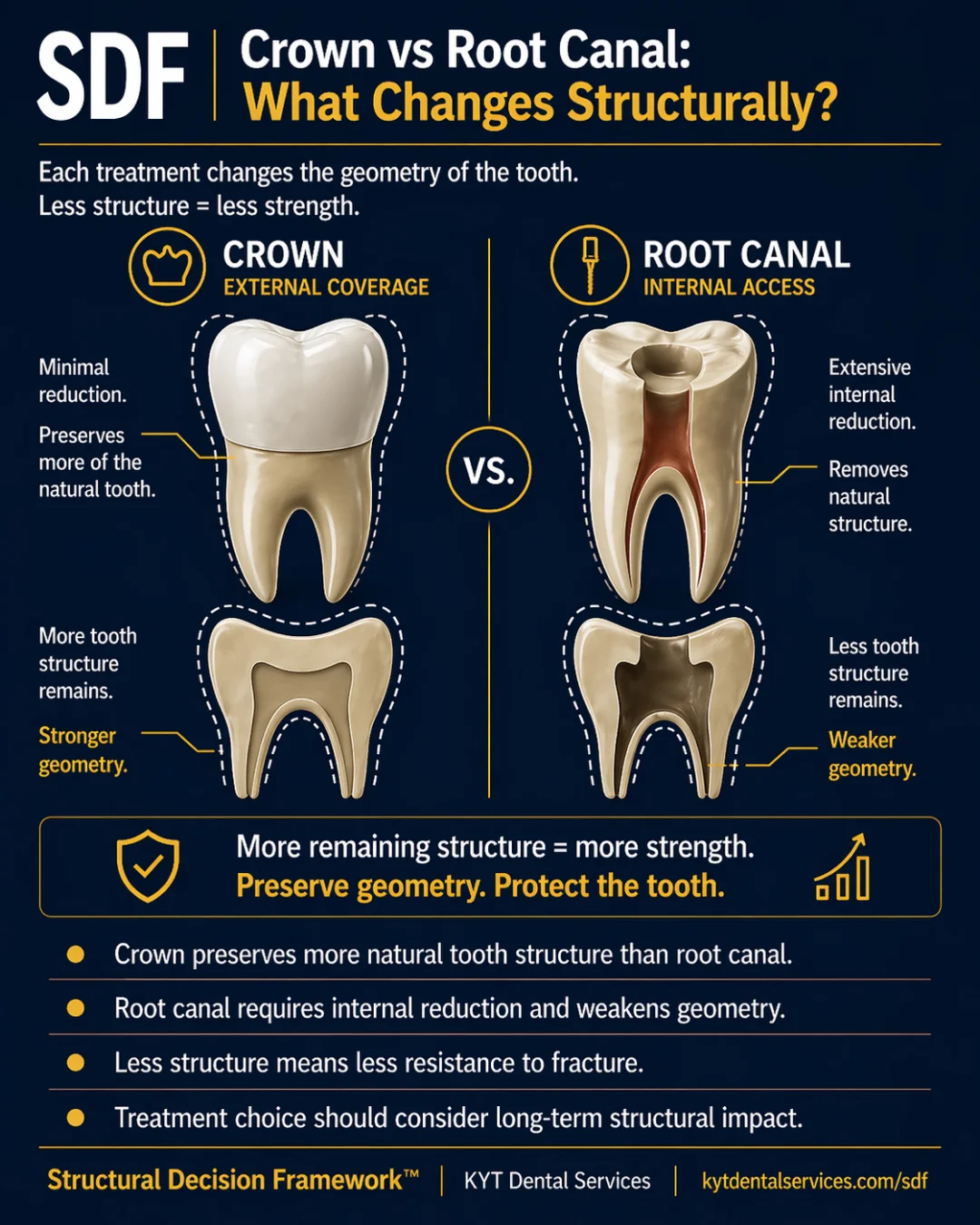
A crown shaves the outside. A root canal hollows out the inside. Both work, but one preserves more of the tooth than the other.
↓ Open the model
Inside the Model
Read the diagram.
Through the Structure lens, every procedure has a structural cost, how much natural tooth it removes. Crown vs Root Canal is the card that compares those costs head-to-head. Both procedures can save a tooth, but they don't leave it in the same shape. The earlier the problem is addressed, the more structure is preserved.
Fig. 12 · Crown vs Root Canal: What Changes Structurally?
SDF Framework
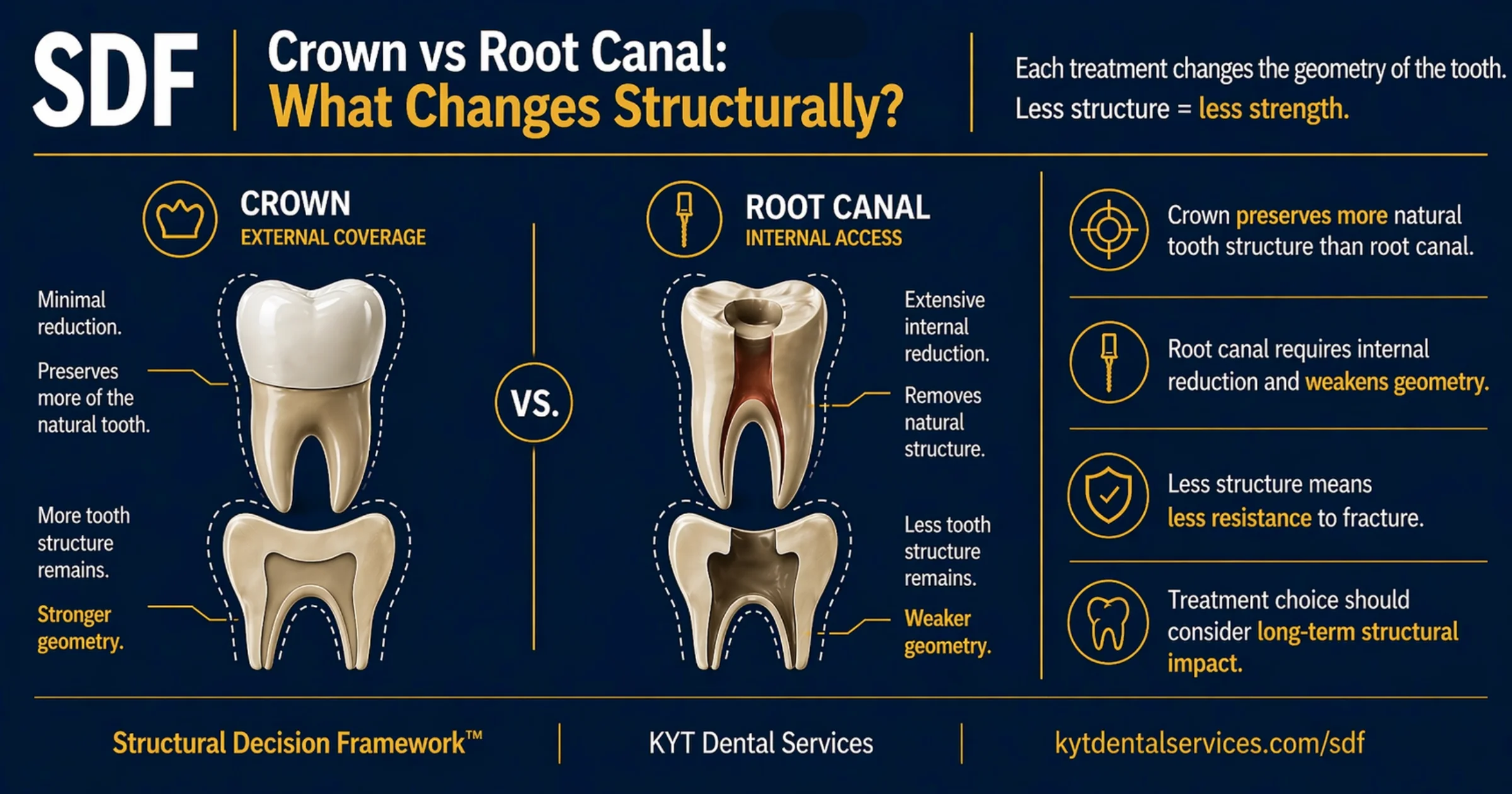
A crown and a root canal can both save a tooth, but they don't change it the same way. A crown reduces a small outer layer and covers what's left. A root canal opens the tooth from the inside and removes structure from the chamber down through the roots. Less structure means less geometric strength, and that's why the same tooth handled earlier (with a crown) tends to last longer than the same tooth handled later (after a root canal).
Explanation
Most people think of a crown as 'more dentistry' than a root canal because it's external and visible. Structurally, the opposite is closer to true. A crown takes a thin layer off the outside of the tooth, usually about a millimeter, to make room for the cap. The bulk of the natural tooth, especially the dentin core that gives the tooth its strength, stays. A root canal needs internal access. The dentist opens the top, removes the pulp, and shapes the canals, which means removing dentin from the chamber down through the root. The tooth still functions, but the geometry is hollowed out. Less internal structure means less resistance to fracture under chewing force, which is why root canal teeth almost always need a crown afterward anyway. The card isn't an argument against root canals, they're sometimes the only option. It's the reason for catching things earlier, while a crown alone can still solve the problem.
Key takeaways
- A crown removes a thin outer layer; a root canal removes substantial internal structure.
- Both procedures save the tooth, but they leave different amounts of natural tooth behind.
- Less structure means less resistance to fracture, even after the procedure is done.
- Most teeth that have a root canal end up needing a crown anyway, on top of the lost internal structure.
- Treatment timing matters, earlier intervention preserves more of the tooth.
In the chair
How it shows up.
01
Caught at the right time
A patient has a deep cavity that's close to the nerve but hasn't reached it. A crown is placed before the pulp gets involved. The tooth keeps its internal structure, the crown protects the outside, and the tooth keeps working for decades. The 'big procedure' was avoided not because nothing was wrong, but because something was done in time.
02
Past the threshold
Same tooth, same patient, but now the cavity has reached the nerve. A crown alone won't work, the pulp is involved. The path forward is a root canal first, then a crown on top. The tooth is saved, but with much less internal structure than the version above. Same outcome on paper. Different geometry underneath.
03
The tooth that's been through it
A tooth with an old root canal and a crown that's now ten years in. It looks fine, but the internal geometry is what it is, hollowed out from the original procedure. This is the tooth that's more likely to crack under heavy chewing or grinding, because there's less structure to absorb the force. The lesson isn't to avoid root canals when needed; it's to keep watching the teeth that have had them.
Through other lenses
The same idea, three other ways.
The whole comparison is structural. A crown takes a thin outer layer. A root canal takes a much larger volume of internal dentin. The structural cost of each procedure decides how much tooth is left to handle force afterward.
After a root canal, the same chewing force concentrates on less remaining structure. That's why crowning a root-canaled tooth isn't optional, it's how you keep the weakened geometry from cracking under load.
Time is the variable that decides which procedure you end up needing. The earlier a structural problem is addressed, the more likely a crown alone is enough. The longer it runs, the more likely the pulp gets involved and a root canal becomes necessary.
Common questions
FAQ.
Is a crown actually less work than a root canal?+
Structurally, yes, the amount of tooth removed is smaller, mostly external. In chair time, a crown is shorter. But 'less work' isn't really the right frame; the right question is which one the tooth needs. A crown alone works when the pulp is healthy. Once the pulp is involved, a root canal first becomes the only path.
Why do root canal teeth almost always get crowned afterward?+
Because the procedure removes internal structure that the tooth was relying on to resist fracture. Without external coverage, the weakened geometry tends to crack under normal chewing forces. The crown after a root canal isn't 'more dentistry', it's what the tooth needs to keep working with less internal support.
If a crown preserves more structure, why don't dentists just crown every tooth early?+
Because a crown still costs structure, the thin outer layer that's removed isn't free. For a tooth that's still strong and not at risk, the right answer is to do nothing. Crowning early only makes sense when the tooth is past the threshold where a filling is enough but before the pulp gets involved. Most of the framework is about reading where each tooth is on that scale.
Are root canals bad for the tooth?+
Not bad, sometimes necessary. They save teeth that would otherwise be extracted. The point isn't that root canals are wrong; it's that they have a higher structural cost than a crown. If the choice is root canal vs extraction, the root canal is almost always the better outcome. If the choice is crown now vs root canal + crown later, earlier is structurally better.
How long do teeth last after a root canal?+
It varies widely, some last decades, some fail in a few years. The two biggest factors are whether a crown was placed afterward (it almost always should be) and how much force the tooth takes (heavy bites and grinders fail sooner). The structural cost of the procedure doesn't go away, it just gets managed by the crown and by reducing force where possible.
See this lesson in a real case
Stories behind this lesson.
Patient cases where this idea showed up in the chair.
See it in real teeth
From idea to actual cases.
This site explains the idea. The clinical version, with real cases, real X-rays, and what this looks like in actual mouths, lives at KYT Dental Services, the practice this framework comes from.
See it on KYT Dental Services →Keep going