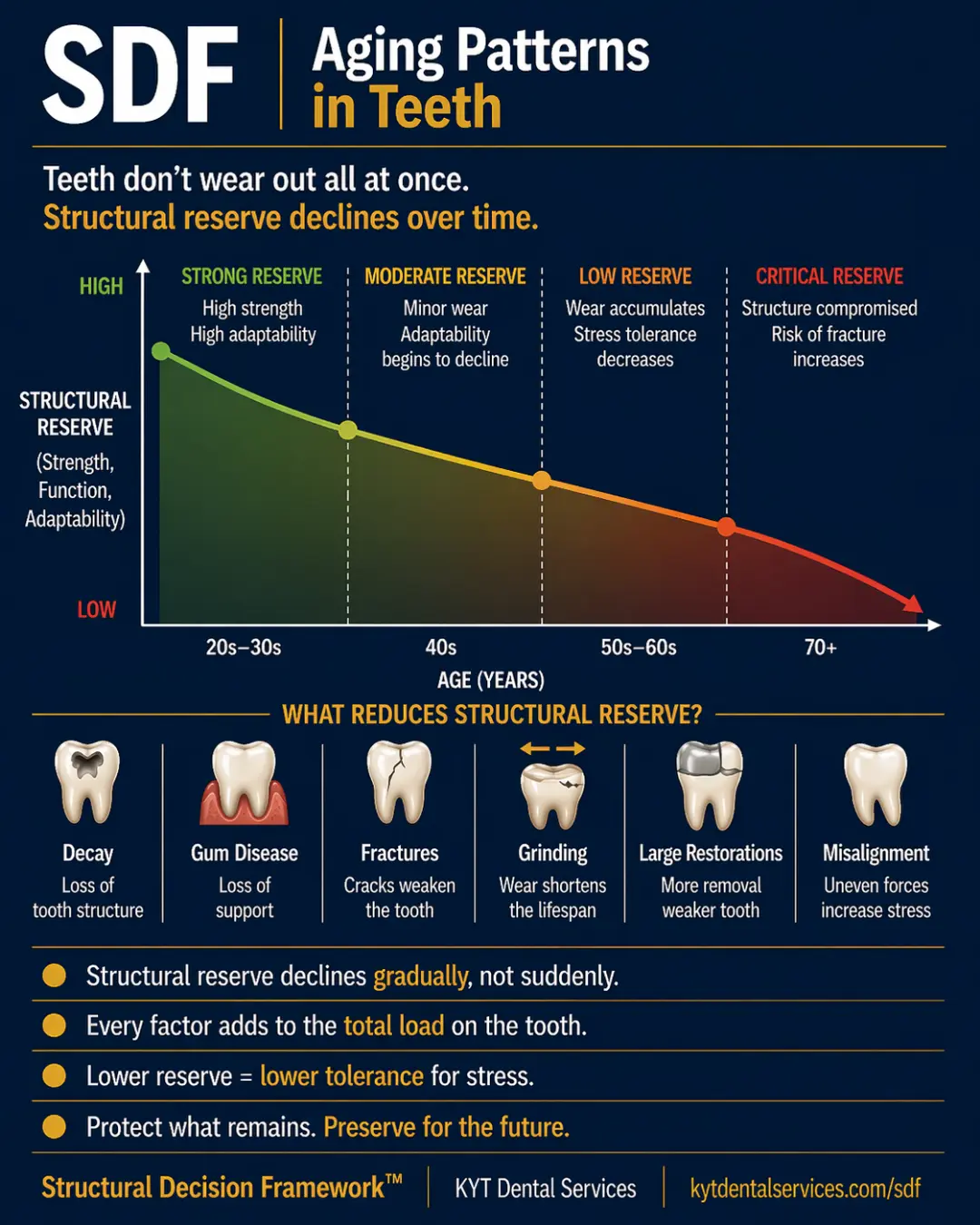
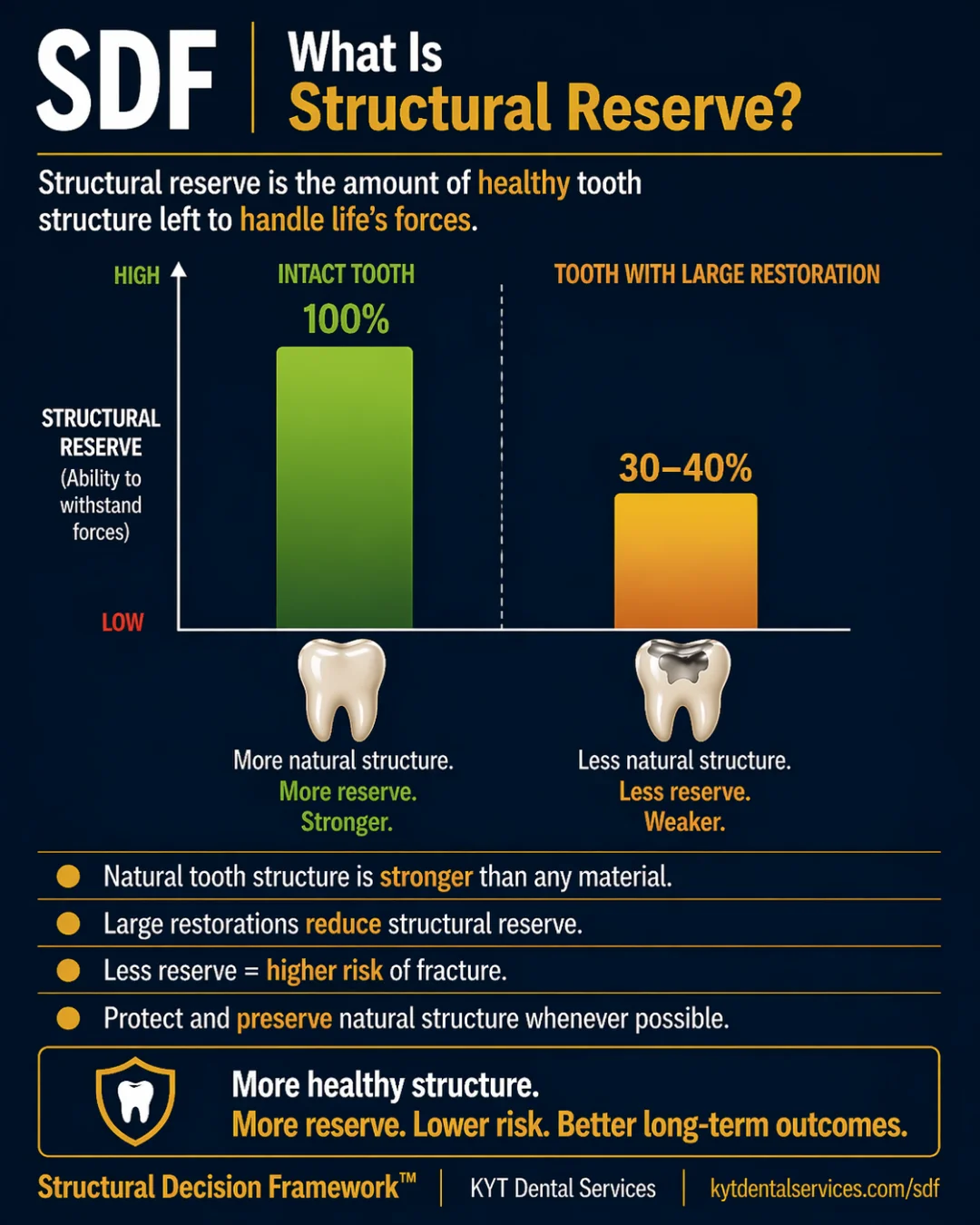
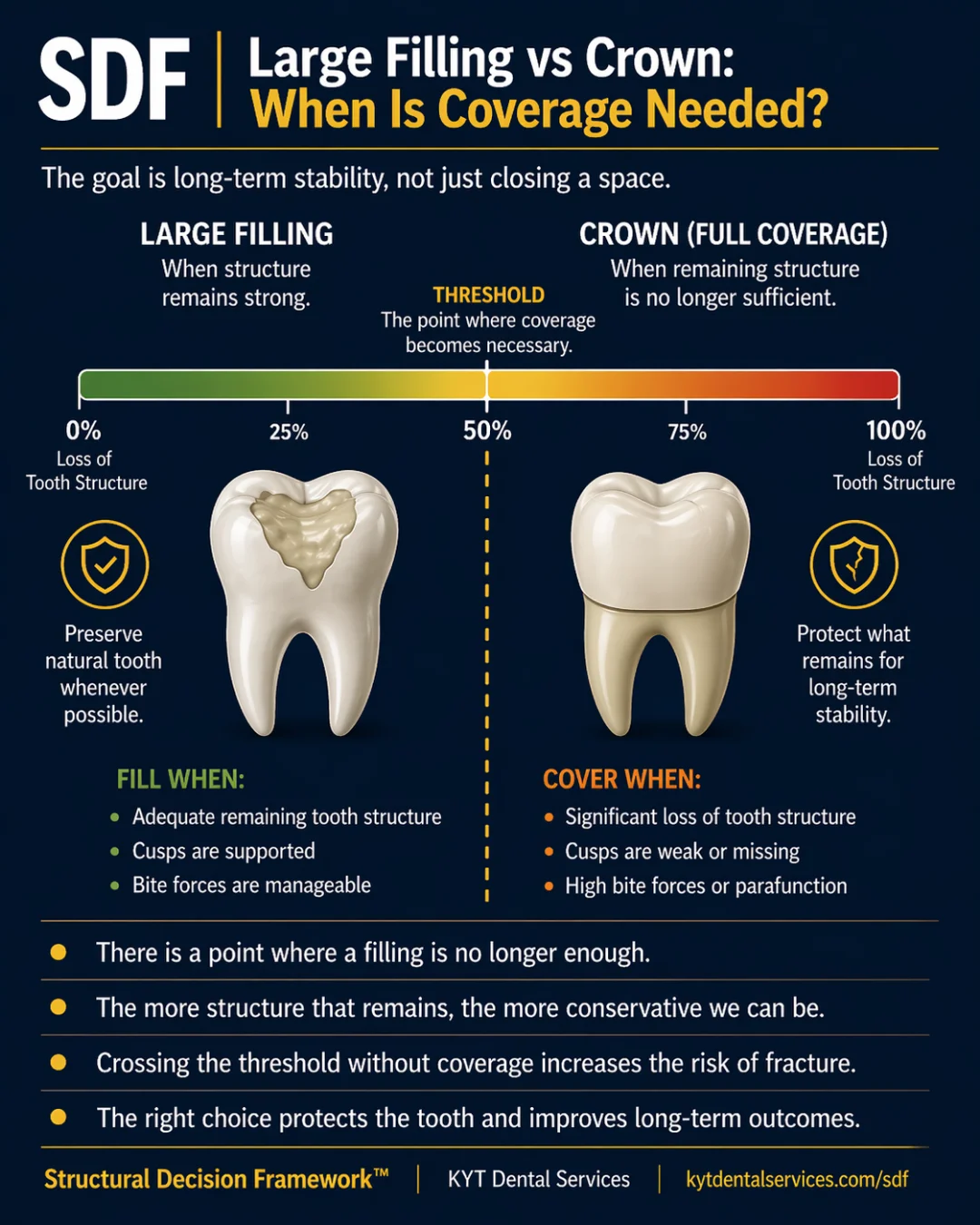
Why Structure Matters
Lesson 04 · Structural Decision Framework
In plain English
We see this all the time: a patient comes in with growing cold sensitivity on a tooth that's never had a problem.
The X-ray looks fine. No cavity. No crack. But under the magnifier we can see what's going on, the enamel on that tooth has worn thin from years of clenching, and the dentin underneath is now closer to the surface than it was a decade ago. The tooth isn't broken. It's just doing its job with one of its layers gone thin.
Here's what most people don't realize about teeth:
A tooth isn't one thing. It's four layers, working as a team, enamel on the outside (the hardest substance in your body, designed to take wear), dentin underneath (softer, but flexible, it absorbs and distributes the force), pulp at the core (the nerve and blood supply that keeps the tooth alive), and the root (anchors the whole thing into your jawbone).
Each layer has a job. Each one protects the next. Lose enamel and the dentin starts taking forces it wasn't built for. Lose enough dentin and the pulp gets too close to the surface. Lose the pulp and the tooth survives but it's no longer adapting to stress. Lose the root and there's nothing left to save.
This is why dentistry isn't really about fixing teeth, it's about preserving layers. The treatment that costs you the least layer is almost always the one that lasts the longest.
When a dentist says "let's protect this tooth before something happens," they're usually looking at a layer that's getting thin. Catching it before the next layer gets exposed is the whole game.
The Lesson
One idea. One lesson.
Every idea in the Structural Decision Framework gets its own lesson. Hover to feel the foil.
SDF-04
StructureWhy Structure Matters
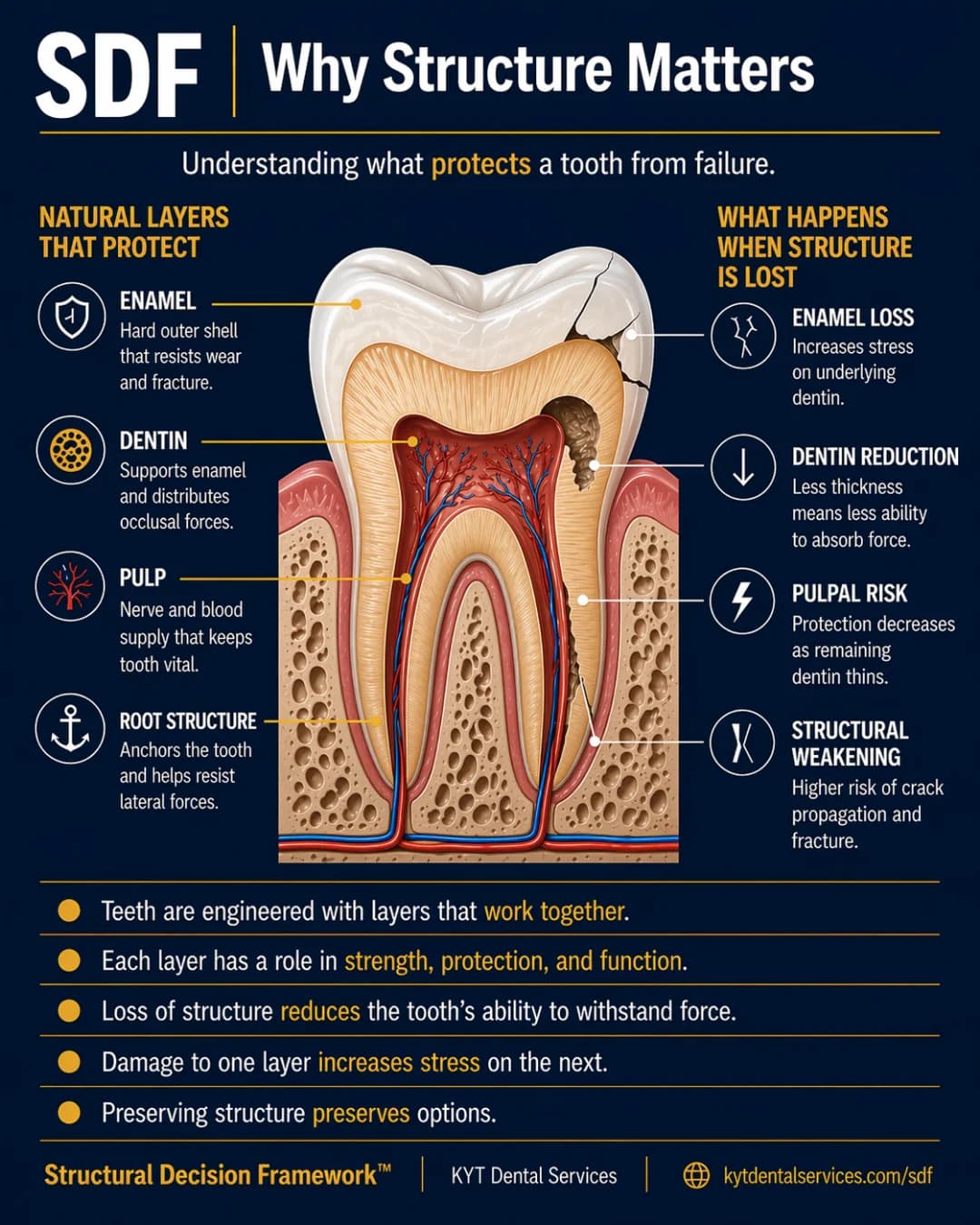
A tooth isn't one thing, it's four layers working together. Lose any of them, and the others have to work harder.
↓ Open the model
Inside the Model
Read the diagram.
Through the Structure lens, every tooth is actually four teeth stacked together, outer enamel, structural dentin, vital pulp, anchoring root. Each one has a role, and they only work because the others are intact. Why Structure Matters is the card that explains what each layer does, and what happens when one of them stops doing it.
Fig. 04 · Why Structure Matters
SDF Framework
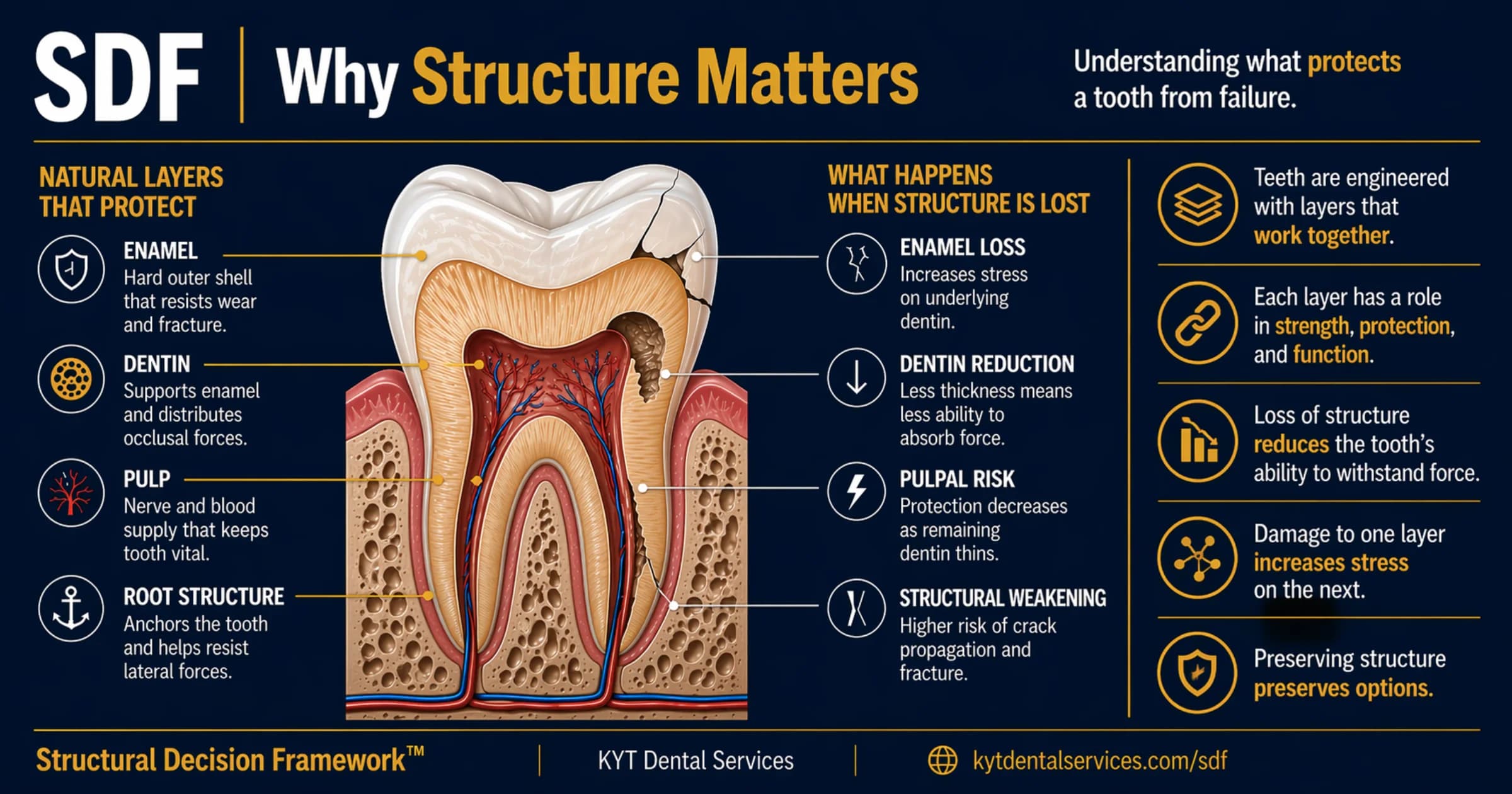
Your tooth isn't one thing, it's four layers, each doing a different job. Enamel takes the wear. Dentin absorbs the force. Pulp keeps the tooth alive. The root holds everything in place. They only work because they all show up.
Explanation
When one layer is damaged or lost, the rest of the tooth has to compensate. Lose enamel, and the dentin underneath suddenly takes stress it wasn't designed for. Lose enough dentin, and the pulp gets exposed. Each layer protects the next, and structural failure is what happens when too many layers get thin.
Key takeaways
- Your tooth has four layers, enamel, dentin, pulp, root, and they're a team.
- Each layer has a specific job: strength, force distribution, vitality, anchoring.
- Losing structure shrinks the tooth's ability to handle normal force.
- When one layer is damaged, the next one takes more stress than it should.
- The more original structure you keep, the more options you have later.
In the chair
How it shows up.
01
The worn-down chewing surface
You don't grind hard, but you've ground for years. The enamel on your back teeth is slowly wearing down. No pain, no symptom. But the dentin underneath is closer to the surface than it should be, and it absorbs force differently than enamel does. The tooth still works, just with less of its top layer doing the protecting.
02
The deep cavity that almost reached the nerve
A cavity that started small wasn't caught for a year. By the time it gets filled, much of the dentin under it is gone. The nerve is now closer to the surface than it should be. The tooth is fine for now, but the safety margin has gone from 'plenty' to 'just enough.' The next event matters more.
03
The cracked root
A back tooth with a deep filling cracks vertically into the root. Above the gum, the tooth looks fine. But the root crack means the foundation is compromised, and there's no good way to patch a root. This is one of the few situations where saving the tooth becomes very hard, because the layer that anchors everything else is broken.
Through other lenses
The same idea, three other ways.
Each layer evolved to handle a specific kind of force. Enamel handles compression from chewing. Dentin distributes that load deeper. Root absorbs side-to-side forces. When you lose one, the others end up handling forces they weren't built for.
The layers don't replenish. Once enamel wears or dentin is removed for a filling, the tooth permanently has less of that material, and the wear of the remaining layers tends to accelerate.
The treatment that keeps the most layers intact tends to be the most stable in the long run. A small filling that preserves dentin lasts longer than a large one that thins it. A root canal that keeps the root preserves the foundation.
Common questions
FAQ.
What's the difference between enamel and dentin?+
Enamel is the hard outer shell, the white surface you see. It's the hardest substance in your body. Dentin is the layer underneath: yellower, softer, but it absorbs and distributes force into the deeper structure. Most fillings replace dentin; few materials match the toughness of enamel.
If my pulp gets exposed, do I always need a root canal?+
Often, but not always. A pulp that's irritated but healthy can sometimes recover with the right treatment. A pulp that's infected or dying needs a root canal to keep the tooth. The decision usually comes down to how the tooth is responding to cold, heat, and pressure.
Can a worn-down tooth be rebuilt to its original strength?+
Not really. We can rebuild the shape with crowns, fillings, and veneers, but those materials aren't as strong as natural enamel and dentin. The function comes back; the original strength of the natural tooth doesn't.
Why is root structure so important?+
Because it's what holds the tooth in place against side-to-side and twisting forces, not just up-and-down ones. A perfectly intact crown means nothing if the root underneath is failing. The root is the foundation everything else rests on.
How do I know if I'm losing structure faster than normal?+
Look for sensitivity to cold or sweet, teeth that look more yellow or shorter than they used to, and any tooth that feels different than it did a year ago. Your dentist can also point out wear patterns on photos and X-rays year over year, change is the most useful signal.
See this lesson in a real case
The story behind this lesson.
A patient case where this idea showed up in the chair.
See it in real teeth
From idea to actual cases.
This site explains the idea. The clinical version, with real cases, real X-rays, and what this looks like in actual mouths, lives at KYT Dental Services, the practice this framework comes from.
See it on KYT Dental Services →Keep going