What Is Structural Reserve?
Lesson 03 · Structural Decision Framework
In plain English
We see this all the time: a patient looks at the X-ray of their molar and asks why we're suggesting a crown when "it's just a filling that needs replacing."
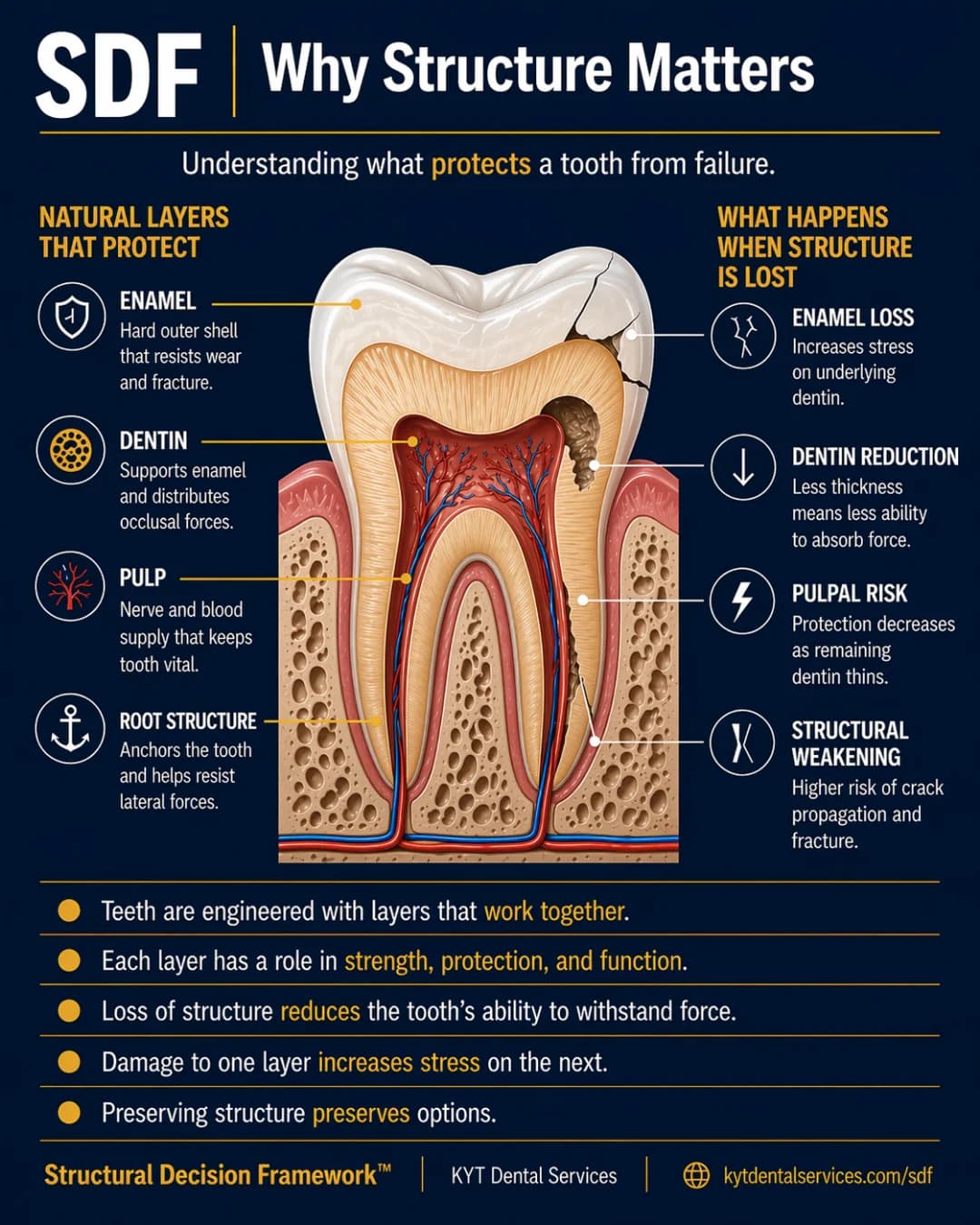
Here's what the X-ray actually shows. That tooth has three previous restorations stacked on top of each other from the last twenty years. The natural tooth left around them, the structure that gives the tooth its strength, is down to about a third of what it was when the patient was 18. The walls are thin. The cusps are unsupported. The tooth has been working at low reserve for years; we just hadn't named it.
This is the part most patients don't think about:
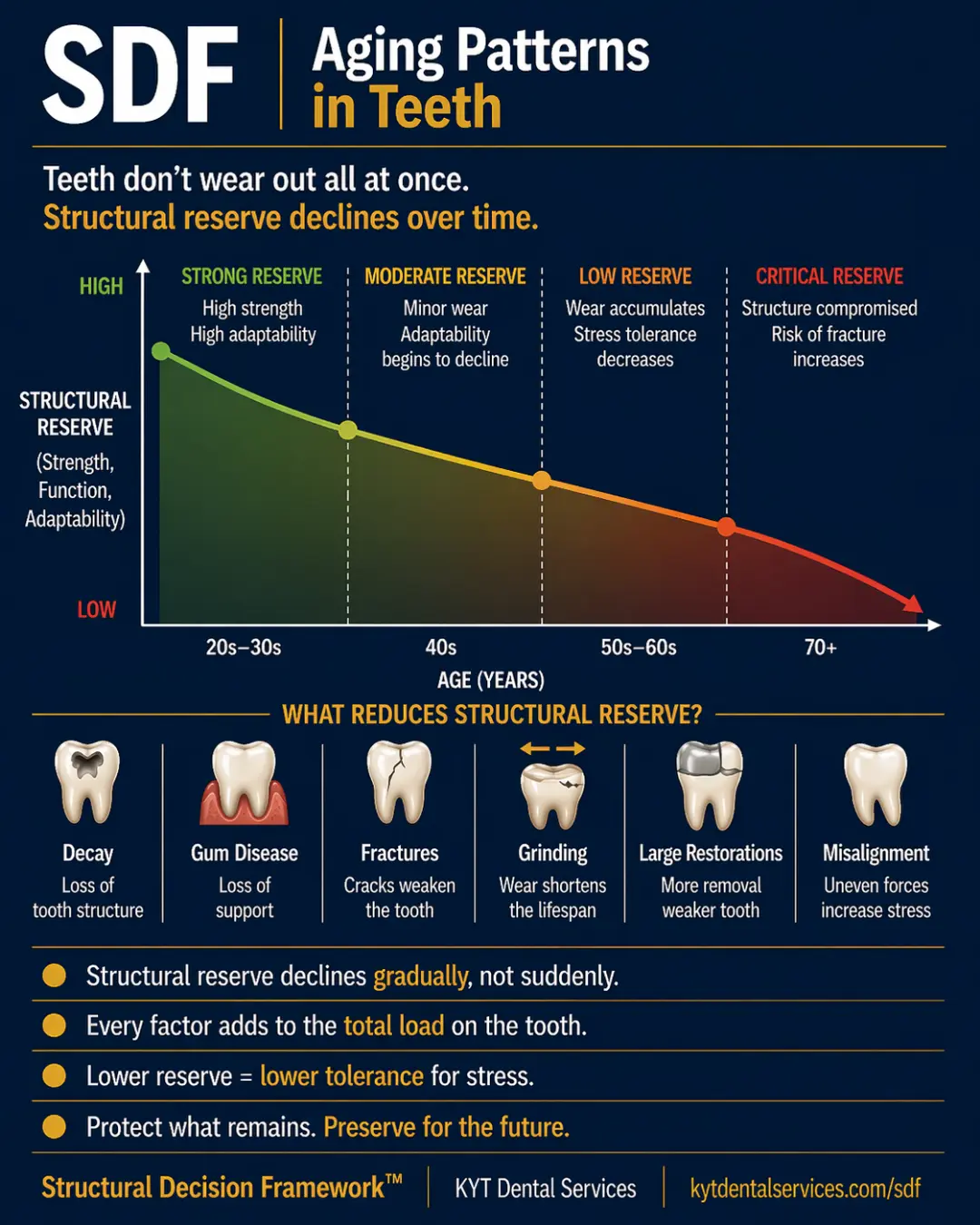
Every tooth starts at 100%. Full strength. Full structural reserve. The first filling drops it to maybe 85%. The next replacement to 70%. A bigger redo to 50%. Eventually you're at 30 or 40 percent, and the natural enamel and dentin you started with, the strongest materials in the body, can't be put back. No filling material is as strong as what it replaces.
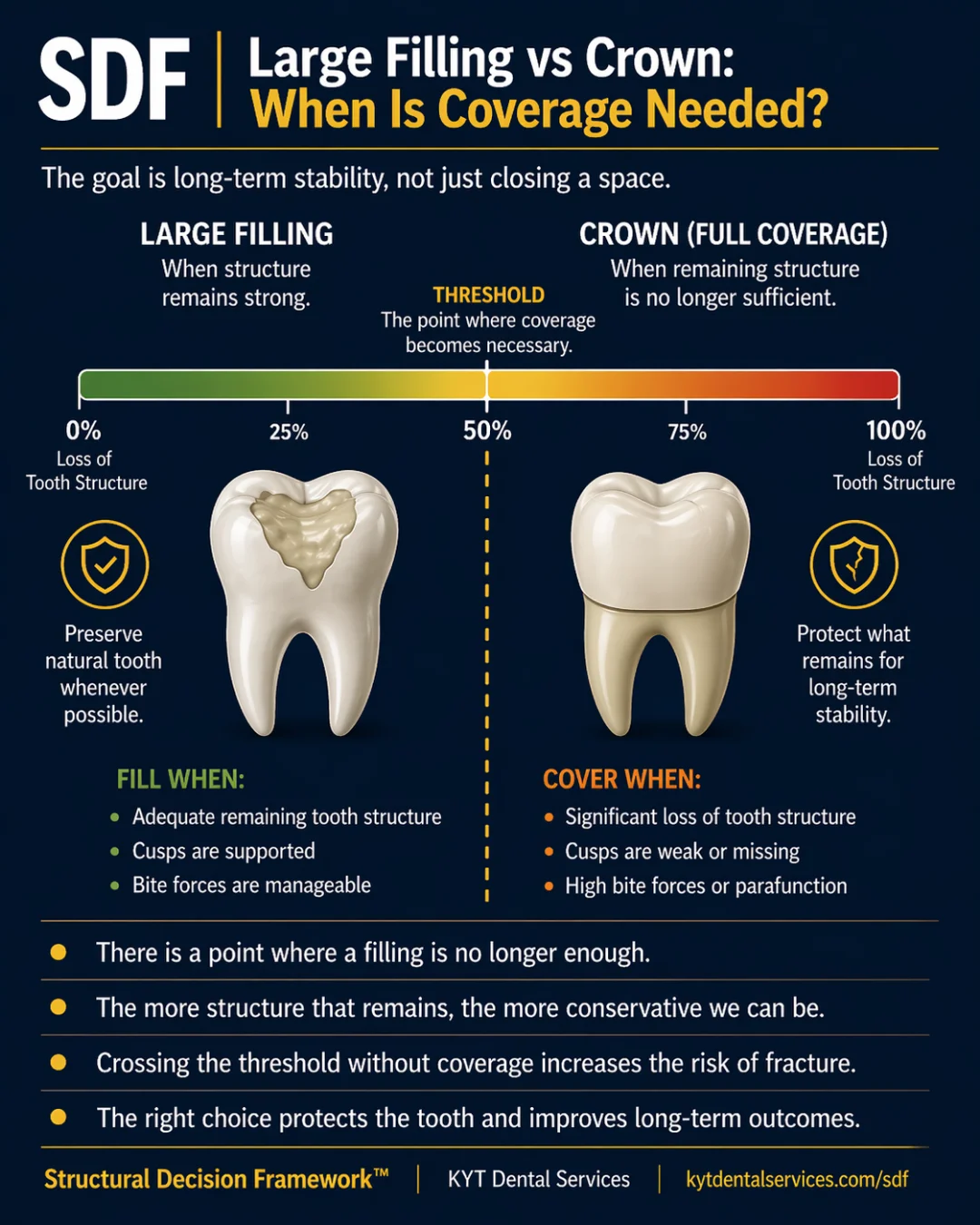
So when a dentist says crown instead of another filling, they're not upselling. They're reading the reserve number. Below a certain threshold, no filling, however well placed, replaces what cusps and walls were doing. The crown wraps the structure that's still there so it doesn't have to do the job alone.
The hardest part of dentistry isn't doing procedures. It's protecting the percentage you started with, because once it's gone, no procedure puts it back.
The Lesson
One idea. One lesson.
Every idea in the Structural Decision Framework gets its own lesson. Hover to feel the foil.
SDF-03
StructureWhat Is Structural Reserve?
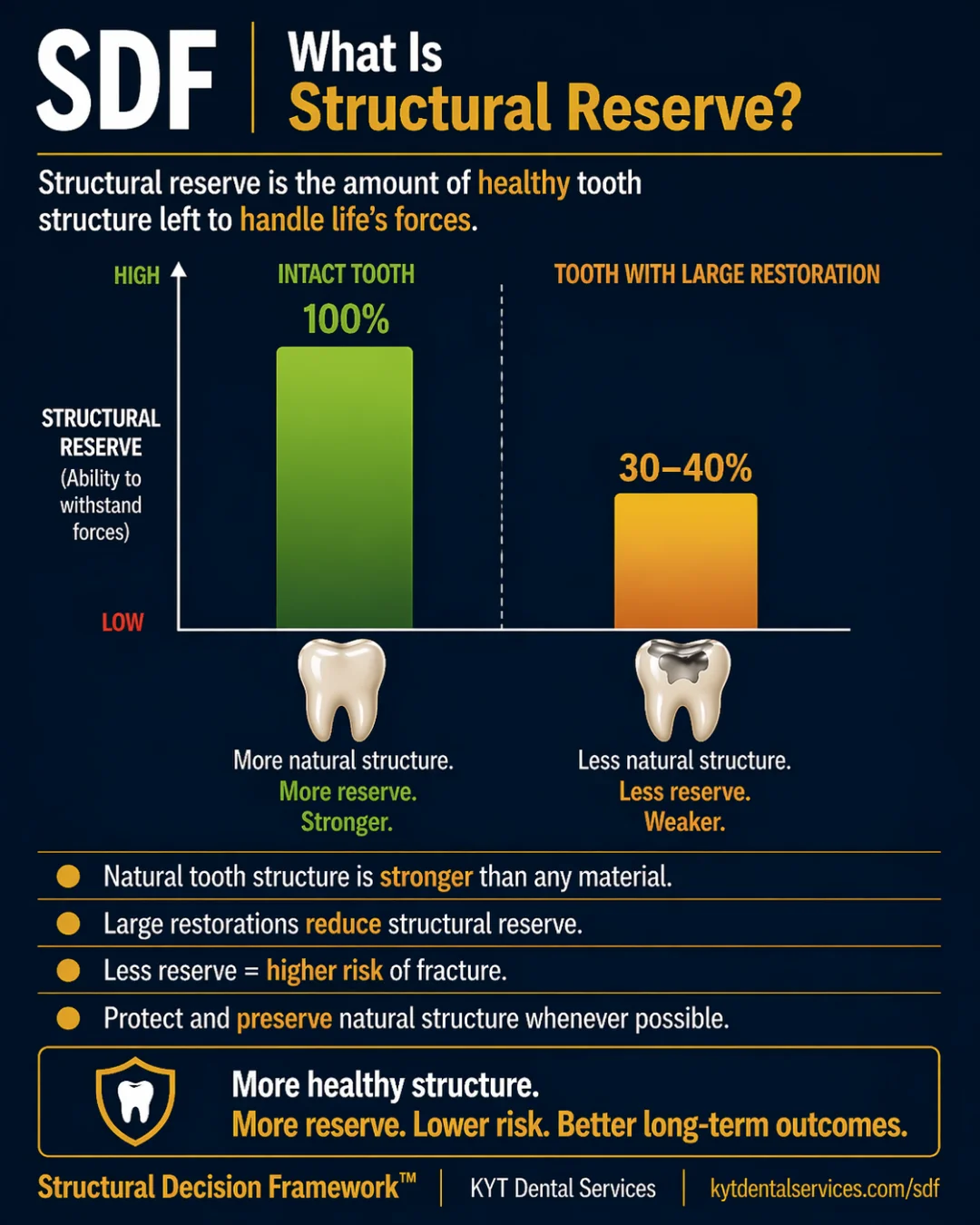
Structural reserve is how much healthy tooth you have left to handle life's forces.
↓ Open the model
Inside the Model
Read the diagram.
Through the Structure lens, every tooth is somewhere on a scale from 100% (intact, untouched) to 0% (gone). Each crack, each filling, each crown takes a piece of that scale away, permanently. Structural reserve is just the technical name for whatever's left. The smaller the number, the less margin the tooth has when life pushes back.
Fig. 03 · What Is Structural Reserve?
SDF Framework
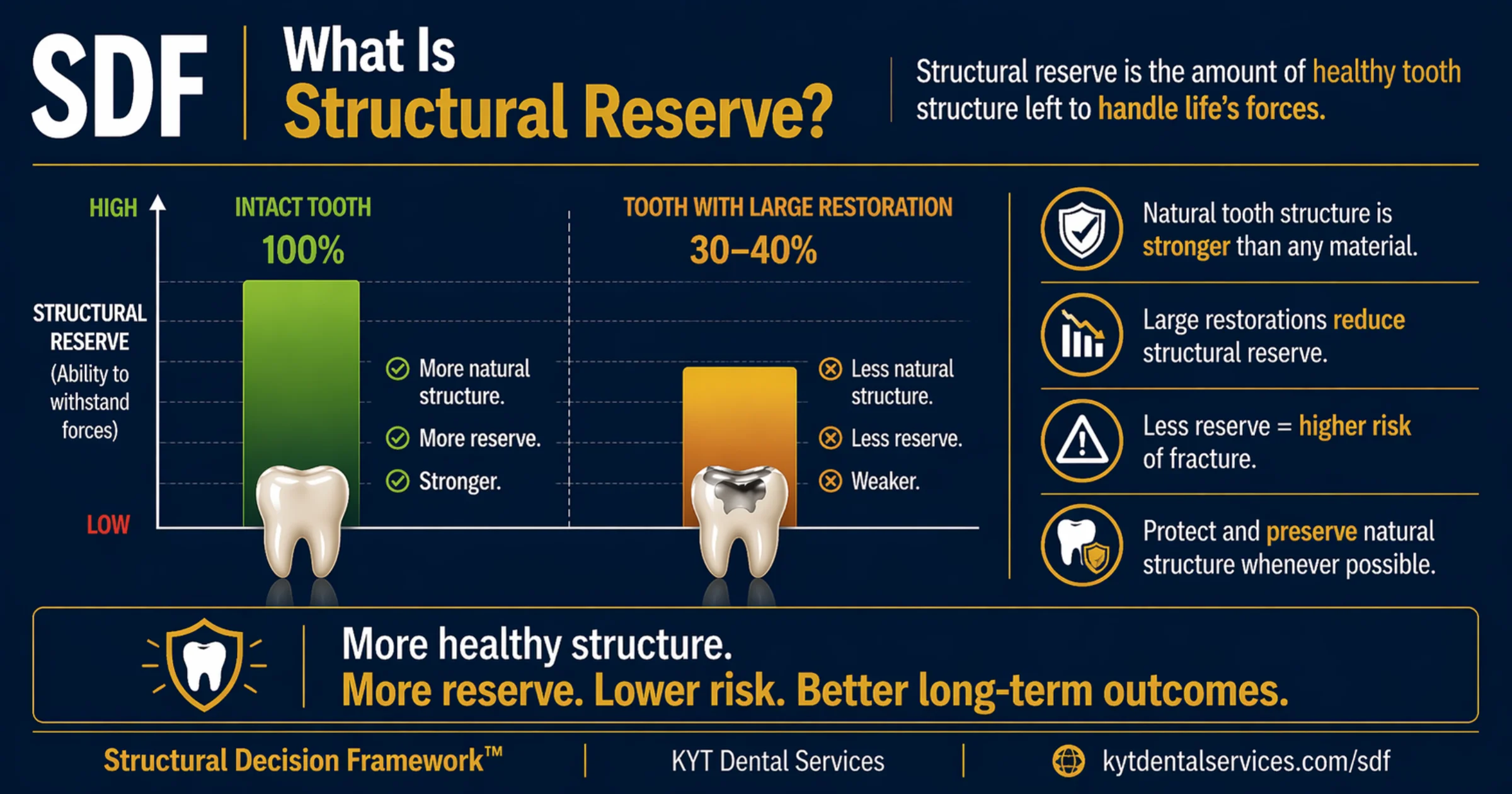
Every tooth starts at 100%, full strength, full reserve. Once you start adding fillings and crowns, that reserve only ever goes one way: down. The bigger the fix, the steeper the drop.
Explanation
Natural enamel and dentin are stronger and more flexible than any filling material. So every time a tooth is restored, you're trading some real tooth structure for a man-made replacement that doesn't perform as well. A small filling barely moves the needle. A large restoration can drop a tooth to 30–40% of its original strength.
Key takeaways
- Natural tooth structure is stronger than anything we can replace it with.
- Big restorations shrink the strength budget, sometimes by more than half.
- Less reserve means a higher chance the next stress is the one that breaks it.
- Protect what's natural before you ever consider replacing it.
In the chair
How it shows up.
01
The 'just a small filling'
It's the first time anything's ever happened to this tooth. The dentist places a small filling. Looks fine, feels fine. But the tooth is no longer at 100%, it's now around 85%. Still strong, still safe, but the timer is running. Each future event starts from a slightly lower number.
02
The crown that became necessary
Years ago you got a big filling. Then a bigger replacement filling. Then a crack. Now the dentist says crown. The reason isn't 'we like crowns', it's that the tooth is at 30–40% reserve. There's not enough natural tooth left to absorb forces directly. The crown is what turns that low number back into something that can chew.
03
The healthy tooth nobody touches
No fillings, no chips, no symptoms. The dentist looks and says 'don't change anything.' That's not laziness, that's protection. A 100% tooth has every option on the table. The moment you start drilling, options come off.
Through other lenses
The same idea, three other ways.
The same bite force lands very differently on a 100% tooth vs a 40% one. Heavy chewing, grinding, and hard foods are what consume the reserve, and the lower the reserve, the more damage each force does.
Reserve only goes down, never up. Every year, every meal, every fix is another withdrawal from an account that doesn't refill. The number on day one is the highest it'll ever be.
The treatment that protects the most natural structure usually wins long-term, even when it costs more or feels harder today. The tooth with more reserve at the end of the procedure is the tooth that lasts.
Common questions
FAQ.
Why is natural tooth stronger than a filling?+
Natural enamel and dentin are layered structures designed to flex slightly under bite force. Fillings, even good ones, are uniform materials that don't flex the same way. The real tooth absorbs and distributes stress; replacements don't quite match it.
If a filling drops me to 85%, is it worth doing?+
Almost always yes, if there's decay, the filling stops the loss. The alternative isn't 100% forever; it's the cavity getting bigger and the tooth ending up at a much lower number. The point isn't to avoid fillings, it's to avoid making bigger ones than necessary.
Can a crown bring my reserve back up?+
No, but it can rescue the function. A crown protects whatever natural tooth is left and lets it keep doing its job. Think of it less like restoring strength and more like wrapping a steel band around the structure that's still holding.
How do I know how much reserve my teeth have?+
Your dentist can tell from a combination of X-rays, the size of existing fillings, the health of the surrounding bone, and how the tooth flexes under bite. There's no single number, but the picture is usually clear within a checkup or two.
What's the single best thing I can do to protect reserve?+
Catch problems while they're small. A tiny filling costs around 5% of reserve. The same cavity ignored for a year can cost 30%. Showing up for cleanings and fixing things early is the highest-leverage move you can make.
See this lesson in a real case
Stories behind this lesson.
Patient cases where this idea showed up in the chair.
See it in real teeth
From idea to actual cases.
This site explains the idea. The clinical version, with real cases, real X-rays, and what this looks like in actual mouths, lives at KYT Dental Services, the practice this framework comes from.
See it on KYT Dental Services →Keep going