Large Filling vs Crown: When Is Coverage Needed?
Lesson 11 · Structural Decision Framework
In plain English
We see this all the time: a patient asks for the simplest, cheapest option, "just a filling."
We pull up the X-ray and the photos. The tooth has more than half of its natural structure gone, the walls are thin, the cusps are barely supported. The patient grinds at night. A filling will technically close the cavity. It will also fracture within a few years and probably take more of the tooth with it.
The cheap option isn't actually cheaper, it's the option that runs out the runway faster.
This is the part most patients don't realize:
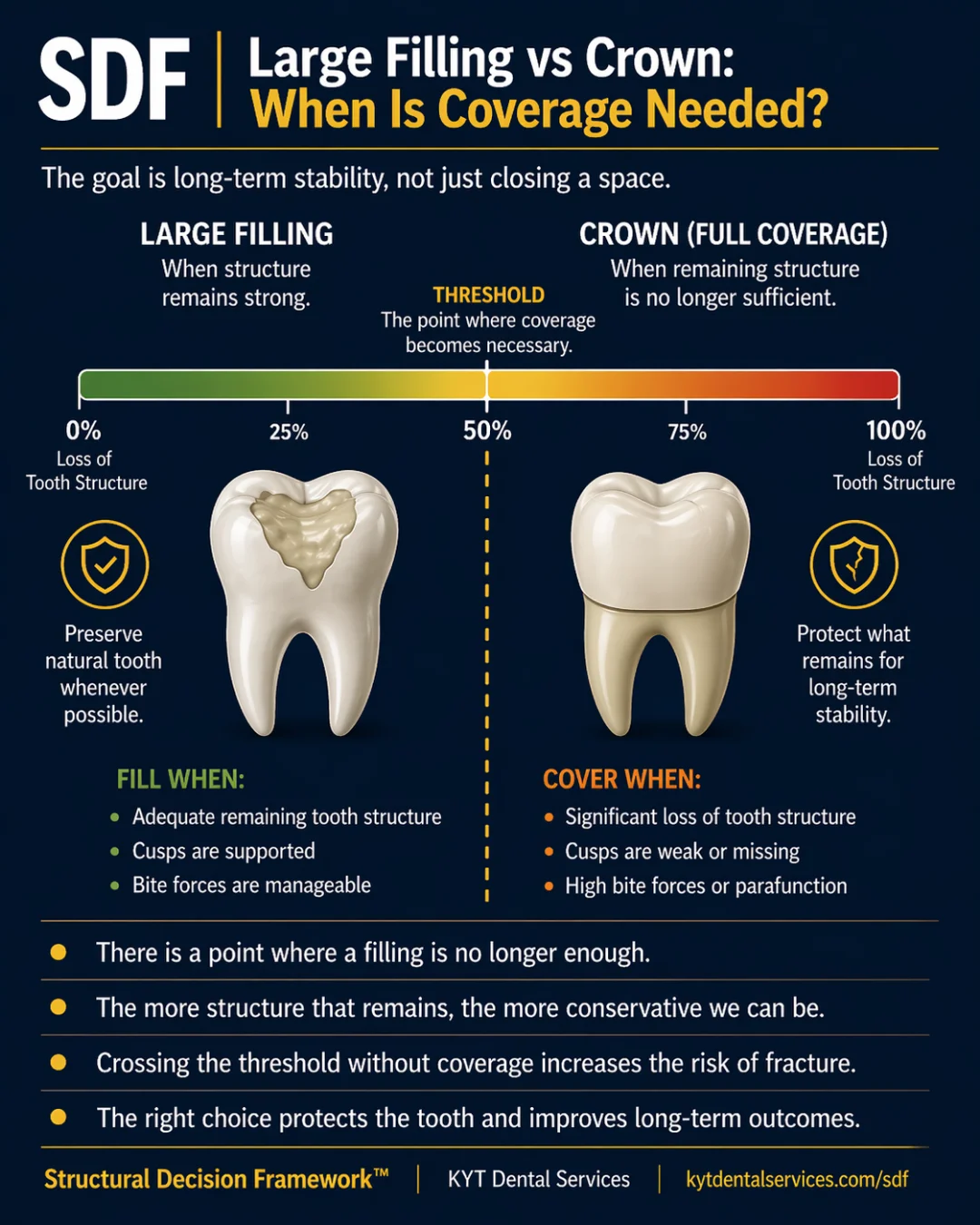
There's a point where a filling stops being enough. The threshold isn't about how the tooth looks, it's about how much natural structure is left. Roughly speaking, once half the tooth is gone, the cusps lose their internal support. They can't take normal chewing force without the natural walls underneath bracing them. A filling fills the space, but the geometry can't hold.
Below the threshold (most of the tooth still there): a filling is the right call. Doing more would remove healthy structure for no gain.
Above the threshold (more than half gone, cusps unsupported): only coverage, a crown, keeps the remaining structure from doing the job alone. The crown isn't more dentistry. It's what the tooth needs to keep working.
The threshold also moves with force. A patient who grinds crosses it sooner than someone with a clean bite. Two teeth with the same amount of structure left can need different treatments because the force loads on them are different.
When a dentist says crown instead of another filling, it's almost always this math. The goal isn't doing less or more, it's long-term stability. Sometimes the smallest current procedure is the one that fails fastest.
The Lesson
One idea. One lesson.
Every idea in the Structural Decision Framework gets its own lesson. Hover to feel the foil.
SDF-11
StructureLarge Filling vs Crown: When Is Coverage Needed?
There's a point where a filling stops being enough. The question isn't if, it's where the threshold is for your tooth.
↓ Open the model
Inside the Model
Read the diagram.
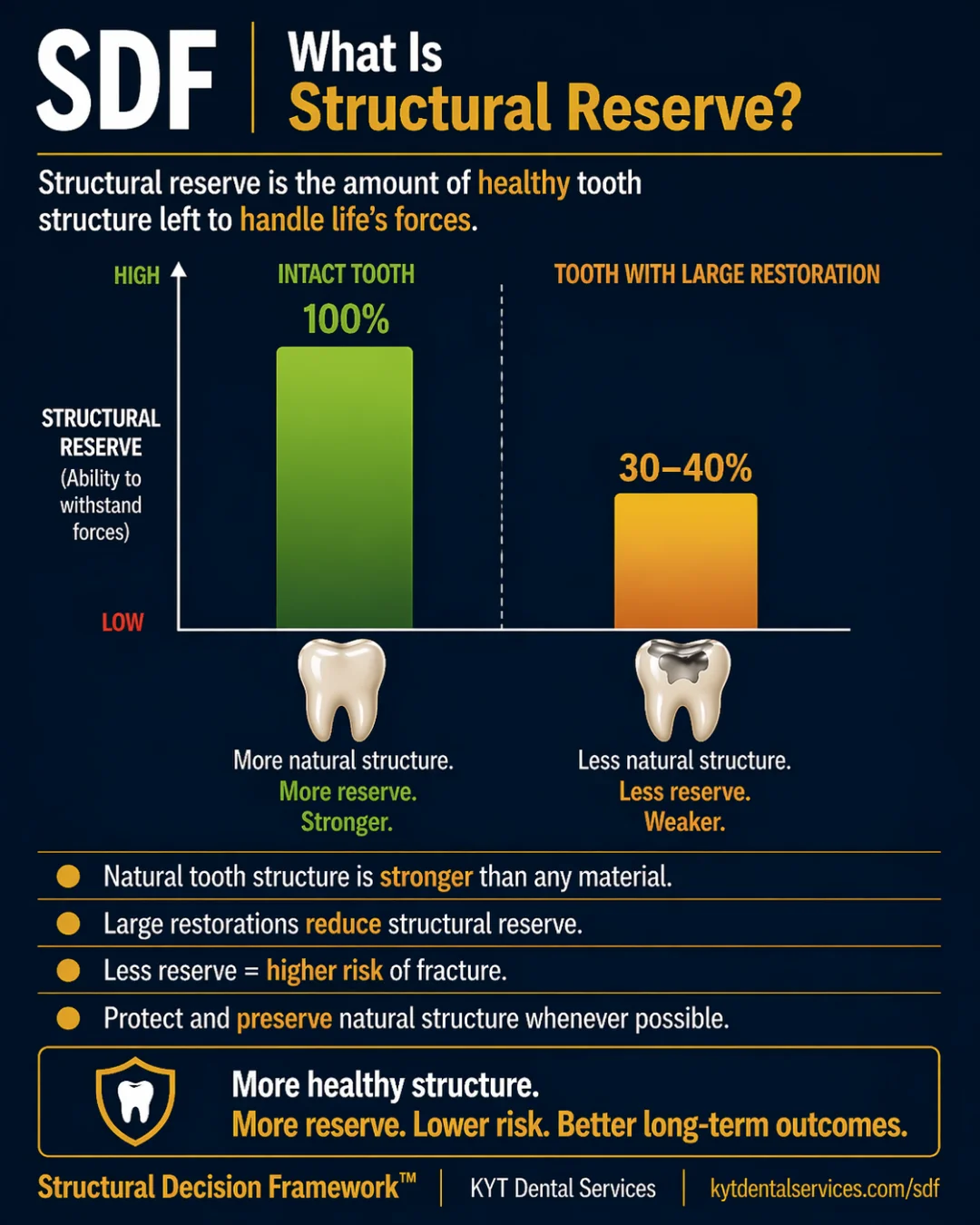
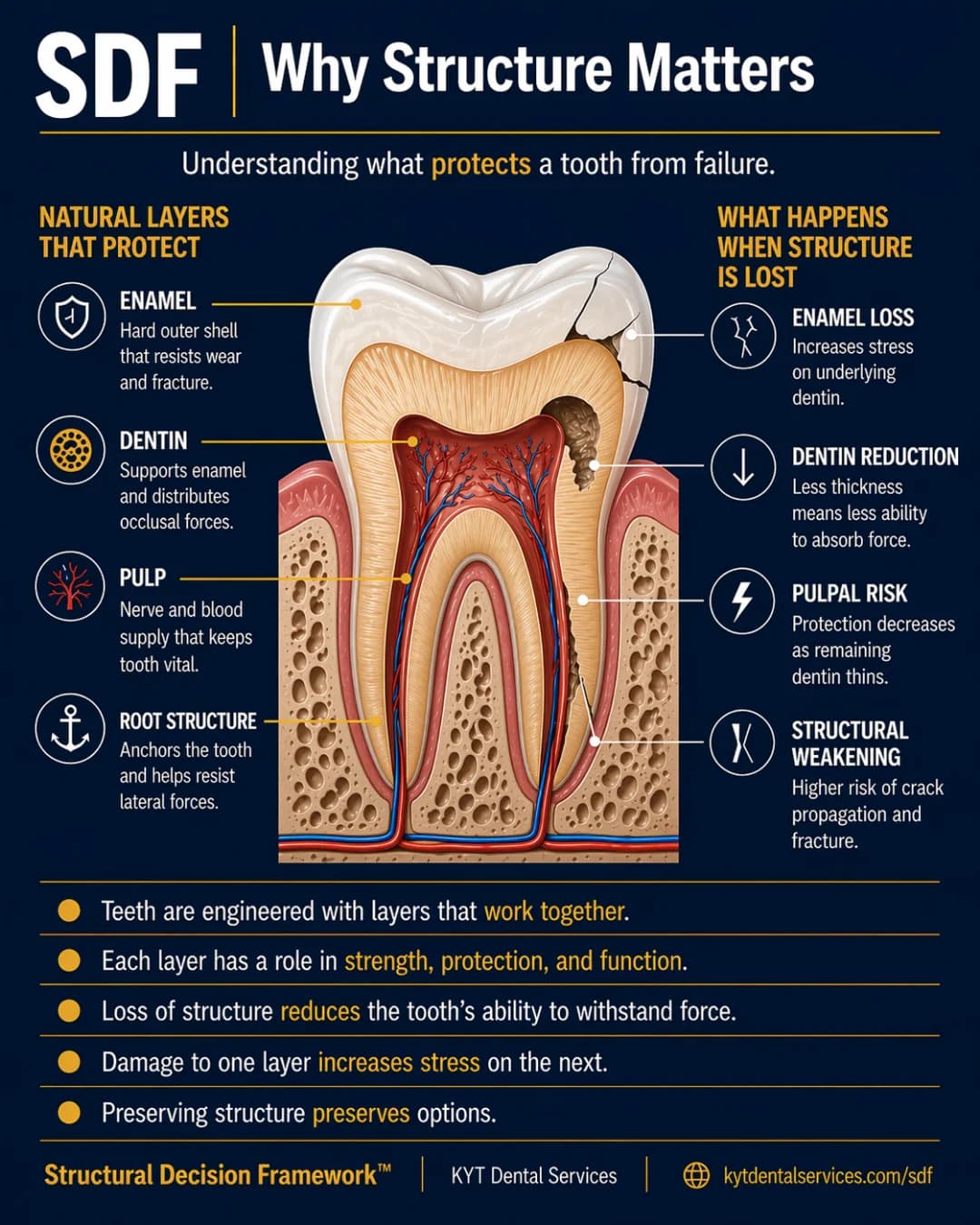
Through the Structure lens, every tooth has a budget of natural structure to spend. Once enough of it is gone, no filling, however well done, can replace what cusps and walls do for stability. Large Filling vs Crown is the card that names the threshold and asks the actual question: how much real tooth is left, and is it enough to take the load?
Fig. 11 · Large Filling vs Crown: When Is Coverage Needed?
SDF Framework
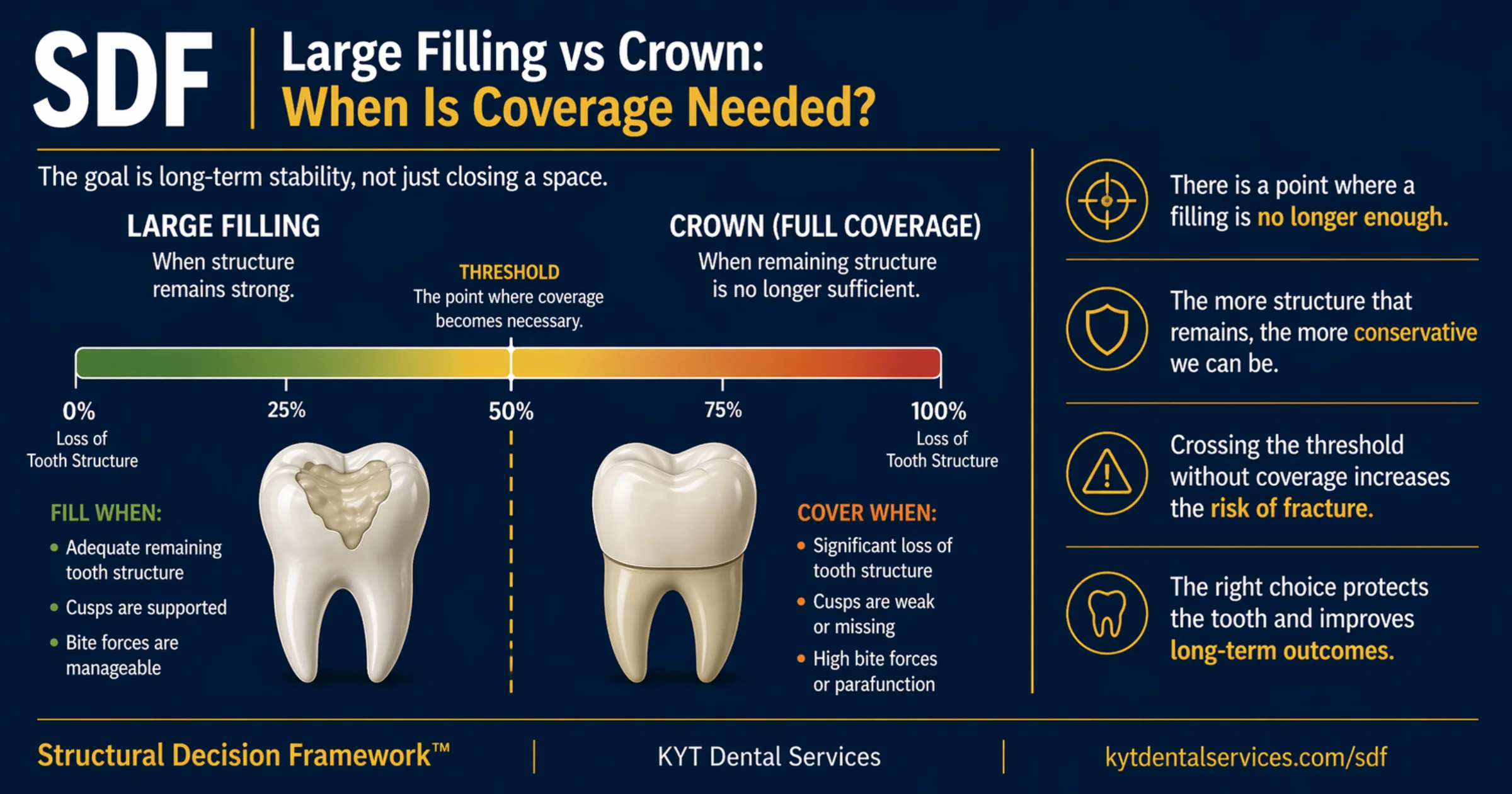
A filling closes a space. A crown covers the whole tooth. The choice between them isn't about preference, it's about a threshold. When enough natural tooth is left to handle chewing forces, a filling holds. When too much is gone, the cusps lose their support, and the tooth needs a crown to stay stable. The goal is always long-term stability, not doing the least or the most.
Explanation
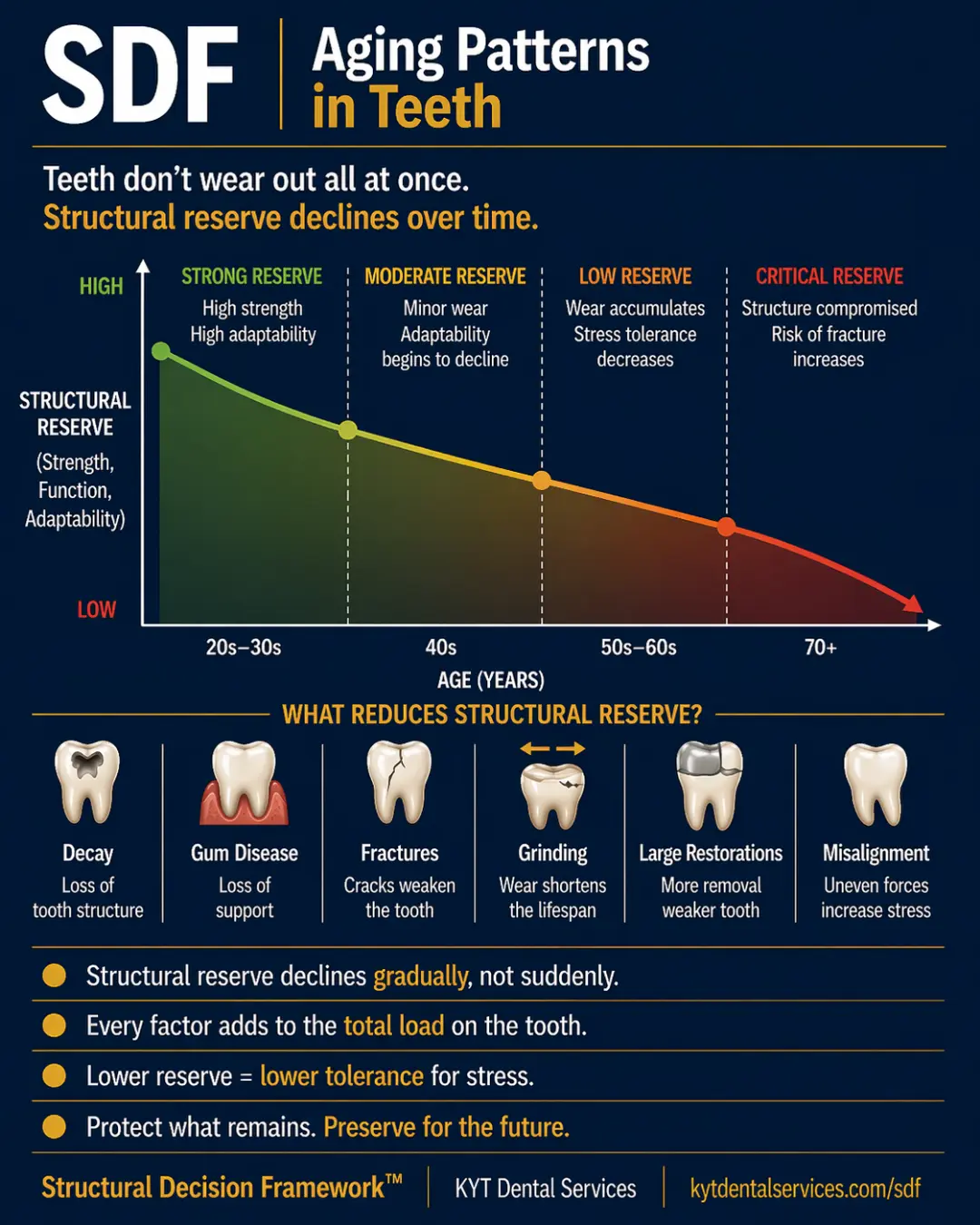
Most teeth that need restorative work fall on a spectrum. On one end, a small or moderate amount of structure is missing, the cusps (the points that bear chewing force) are still solid, and the bite forces it sees are normal. A large filling can close the gap and the tooth keeps working. On the other end, much of the natural tooth is gone, the cusps are unsupported or already cracking, and forces are concentrated on what's left. A filling there can look fine for a while and then fail, usually with a fracture that takes more of the tooth with it. Somewhere in the middle is the threshold. Crossing it without coverage is what turns a 'small problem' tooth into a tooth that needs a root canal or extraction later. The crown isn't more dentistry for its own sake; it's what keeps the remaining tooth from doing the job alone.
Key takeaways
- There's a point where a filling is no longer enough, and it's mostly about how much natural tooth is left.
- The more structure that remains, the more conservative the right choice is.
- Crossing the threshold without coverage raises the risk of fracture, not just decay.
- A crown isn't bigger dentistry, it's coverage for a tooth that can't carry the load alone anymore.
- The right choice protects the tooth and improves long-term outcomes.
In the chair
How it shows up.
01
The borderline tooth
A back molar with a moderate cavity, not tiny, not huge. The cusps are intact, the bite is clean, no grinding. A filling here is a reasonable choice; the tooth has the structure to handle chewing on its own. Coverage would be more than the tooth needs.
02
The cracked-cusp tooth
A tooth with a big old filling, a hairline crack down one cusp, and a patient who grinds. Even if you replaced the filling, the cusp is already failing. This tooth is past the threshold, a crown wraps the structure and stops the crack from becoming a split. Another filling here is what fails.
03
The 'I just want a filling' tooth
A patient asks for the simplest, cheapest option. The dentist looks at the tooth: more than half of it is gone, the walls are thin, the bite is hard. A filling will technically close the cavity. It will also fracture within a few years. The cheap option isn't actually cheaper, it's the option that runs out the runway faster.
Through other lenses
The same idea, three other ways.
The whole decision is structural. How much of the natural tooth is left, and is it enough to do the work, that's the question. Below the threshold, a filling holds. Above it, only coverage keeps the structure from being overloaded.
Force shifts the threshold. A patient who grinds, clenches, or has a heavy bite crosses the threshold sooner than someone with light forces. Force is why two teeth with the same amount of structure left can need different treatments.
The goal is long-term stability, not the smallest possible procedure right now. A filling that fails in five years and takes more tooth with it isn't conservative. A crown that lasts twenty years is.
Common questions
FAQ.
How much tooth has to be gone before a crown is needed?+
Roughly half is the rule of thumb, but it depends on which half. If the cusps are still supported and the bite is light, a tooth past 50% can sometimes still hold a filling. If the cusps are unsupported or the patient grinds, the threshold comes earlier. Your dentist reads structure, cusp support, and force together.
Why does a filling fail in a tooth that's mostly missing?+
Because a filling is held in place by the surrounding tooth. When most of the surrounding tooth is gone, there's nothing for the filling to brace against. The cusps end up doing the work without internal support, and they crack. The failure usually isn't the filling itself, it's the tooth around it.
Is a crown more expensive because it's better dentistry, or because of the lab work?+
Both. A crown costs more because it's a custom-made restoration that involves a lab and more chair time. But the reason it's the right call past the threshold isn't the price, it's that nothing else covers all the cusps and protects the remaining structure from the forces that would otherwise crack it.
Can I wait and just get a filling, then crown it later if it cracks?+
Sometimes, but the crack often takes more of the tooth with it, and 'crowning later' can become 'root canal later' or 'extraction later.' If a tooth is already past the threshold, the safer path is to crown it the first time. If it's borderline, monitoring is reasonable.
Will my dentist always tell me if I'm at the threshold?+
A good one will, and they'll show you the X-ray and the tooth so you can see what they're seeing. If a recommendation feels surprising, ask: how much natural tooth is left, are the cusps supported, and what are the forces this tooth sees? Those are the three things that decide which side of the threshold you're on.
See this lesson in a real case
The story behind this lesson.
A patient case where this idea showed up in the chair.
See it in real teeth
From idea to actual cases.
This site explains the idea. The clinical version, with real cases, real X-rays, and what this looks like in actual mouths, lives at KYT Dental Services, the practice this framework comes from.
See it on KYT Dental Services →Keep going