The SDF Equation
Lesson 10 · Structural Decision Framework
In plain English
We see this all the time: two patients walk in with the same diagnosis, a cracked back tooth, and walk out with completely different treatment plans.
Patient A: small repair plus monitoring at the next checkup. Patient B: full crown plus a nightguard, scheduled within two weeks.
Same diagnosis. Same X-ray finding. Different recommendations. Patients sometimes assume one of us got it wrong. We didn't. We were running the same equation, and the equation gave different answers.
Here's the equation we run on every tooth in your mouth:
Structure + Force + Time = Outcome.
That's the whole Structural Decision Framework in one line. Every dental decision, fill, crown, watch, replace, do nothing, is a question about which of those three variables to manage next.
Patient A had a cracked tooth with most of its natural structure still intact, a clean bite with no grinding, and the crack was caught at a routine cleaning before symptoms started. Structure: high. Force: low. Time: well-watched. The equation says: small repair, watch, no rush.
Patient B had the same crack on a heavily-restored tooth, in a mouth that grinds at night, and the crack had been propagating for months before it was caught. Structure: low. Force: high. Time: already running. The equation says: act now, address the force, protect what's left.
You can't change time. You can sometimes rebuild structure. You can almost always reduce force. The equation doesn't tell us what to do, it tells us where the highest-leverage move is for your specific tooth.
When you understand the equation, every recommendation makes sense, even the surprising ones. And every recommendation that doesn't make sense is worth asking about: which variable was loudest, and what's this targeting?
The Lesson
One idea. One lesson.
Every idea in the Structural Decision Framework gets its own lesson. Hover to feel the foil.
SDF-10
StabilityThe SDF Equation
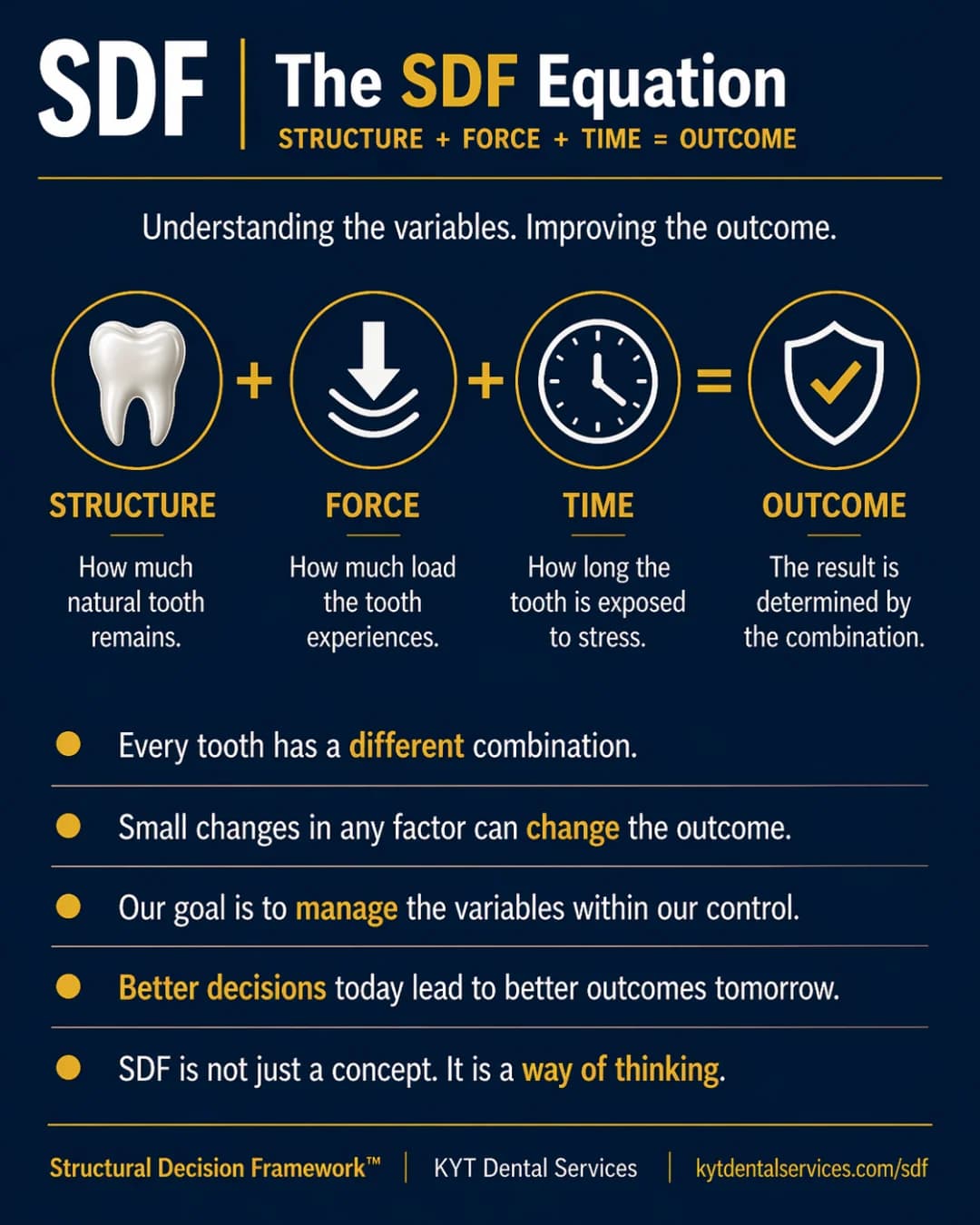
Structure + Force + Time = Outcome. That's the whole framework in one line, and the lens behind every treatment decision.
↓ Open the model
Inside the Model
Read the diagram.
Through the Stability lens, the SDF equation is the master view, the one all the other cards feed into. The SDF Equation is the card that names the whole framework: every outcome you care about is downstream of structure, force, and time. The skill is knowing which of those three to act on first.
Fig. 10 · The SDF Equation
SDF Framework
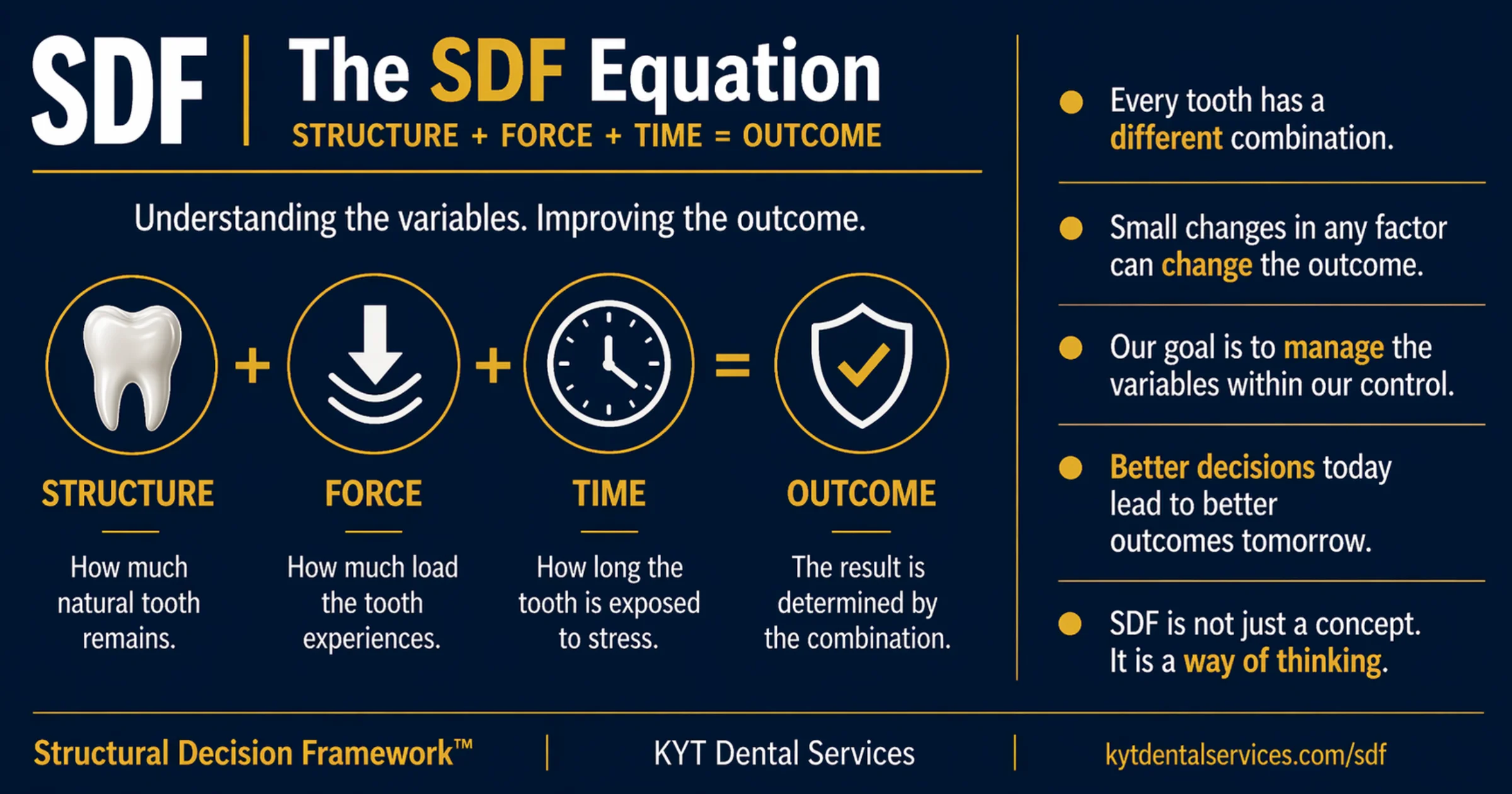
The Structural Decision Framework comes down to one equation. Structure (how much natural tooth is left) plus Force (how much load it takes) plus Time (how long the load has been running) equals Outcome (what happens to the tooth). Every dental decision is a question about which of those three to manage next.
Explanation
Most dental conversations get lost in the specifics, which filling, which crown, which procedure. The SDF equation cuts past all of that. Every tooth has a current value for structure (how much real tooth is left), force (how much it's being pressed on), and time (how long it's been under that pressure). The outcome, how long it lasts, how stable it is, whether it'll need work next year or in twenty years, is the result of those three. You can't change time. You can sometimes rebuild structure. You can almost always reduce force. The equation doesn't tell your dentist what to do, it tells them where the highest-leverage move is for your specific tooth.
Key takeaways
- Every tooth has its own combination of structure, force, and time.
- Small changes in any one factor can shift the outcome significantly.
- The goal isn't to control everything, it's to manage the variables you can.
- Better decisions today are how you get better outcomes tomorrow.
- SDF isn't just a concept. It's a way of thinking about every tooth in your mouth.
In the chair
How it shows up.
01
Same diagnosis, two equations
Two patients walk in with cracked back teeth. Patient A has lots of natural tooth left and a clean bite. Patient B has a heavily-restored tooth and grinds at night. Same diagnosis on paper. Different equations underneath. Patient A might get a small repair; patient B needs a crown plus a nightguard. The framework, not the diagnosis, drives the plan.
02
Why the cheapest option isn't always the right one
A patient asks for the simplest filling. The dentist runs the SDF equation: structure already low, force already high, time already running. A filling barely moves the outcome. What actually shifts the math is a crown plus addressing the grinding. The 'expensive' option is the one that changes the equation; the cheap one is the one that doesn't.
03
The 'do nothing' that makes sense
A patient wants to be aggressive about every tiny thing. The dentist runs the SDF equation: structure intact, force low, time well-monitored. Outcome is stable. The right move isn't more treatment, it's keeping all three factors where they are. SDF can also tell you when not to act.
Through other lenses
The same idea, three other ways.
One of the three variables. Once it's gone, you can't get it back the same way. The equation is biased toward preserving it because it's the hardest one to change after the fact.
One of the three variables, and usually the most adjustable. Lowering force is the fastest way to shift the outcome side of the equation, especially for grinders or people with uneven bites.
The third variable, and the one you can't reduce. You can only catch problems early so time has less to work with. The whole point of regular checkups is to keep time from joining the other two factors.
Common questions
FAQ.
Why is the equation S + F + T instead of S × F × T?+
Both versions work. Plus is easier to picture, each factor adds to the equation. Times is more accurate when factors interact, because a problem in two factors at once is much worse than the sum of two separate problems. Most clinicians think of it as a multiplicative model in their head, but the additive version is friendlier to introduce.
What does 'outcome' actually mean here?+
How long the tooth lasts. Whether it cracks, decays, needs a root canal, or stays stable. Whether the next treatment is small or large. The equation doesn't predict any single moment, it predicts the trajectory.
Which factor should I focus on improving?+
The loudest one in your mouth right now. For most patients, that's force (manageable with nightguards, bite work, dietary changes) or time (managed with regular monitoring). Structure is hardest to recover, so the focus there is preservation rather than gains.
How is this different from the way most dentists already work?+
A lot of dentistry is reactive, fix what's broken, look at one tooth at a time. SDF is a systematic way of asking what's actually driving any given problem and where the highest-leverage intervention is. It's less about disagreeing with conventional dental care and more about making the underlying logic visible to the patient.
Do I need to think about the SDF equation as a patient, or is this just for the dentist?+
Both. As a patient, you don't need the math, you need the intuition. Knowing that every recommendation is some answer to 'which of these three is loudest?' lets you ask your dentist better questions and understand why the same problem has different solutions in different mouths.
See it in real teeth
From idea to actual cases.
This site explains the idea. The clinical version, with real cases, real X-rays, and what this looks like in actual mouths, lives at KYT Dental Services, the practice this framework comes from.
See it on KYT Dental Services →Keep going