The Four Pillars of Structural Stability
Lesson 08 · Structural Decision Framework
In plain English
We see this all the time: a patient with a back tooth that has no fillings, no decay, no cracks, and we still tell them the tooth is at risk.
They look at us like we're crazy. "It's a perfect tooth."
We pull up the periapical X-ray. The crown of the tooth is intact. But the bone level around the root is down significantly from a few years ago. Years of gum disease have been quietly eroding the foundation. The tooth itself is fine. What's holding it in place isn't.
This is the part most people miss:
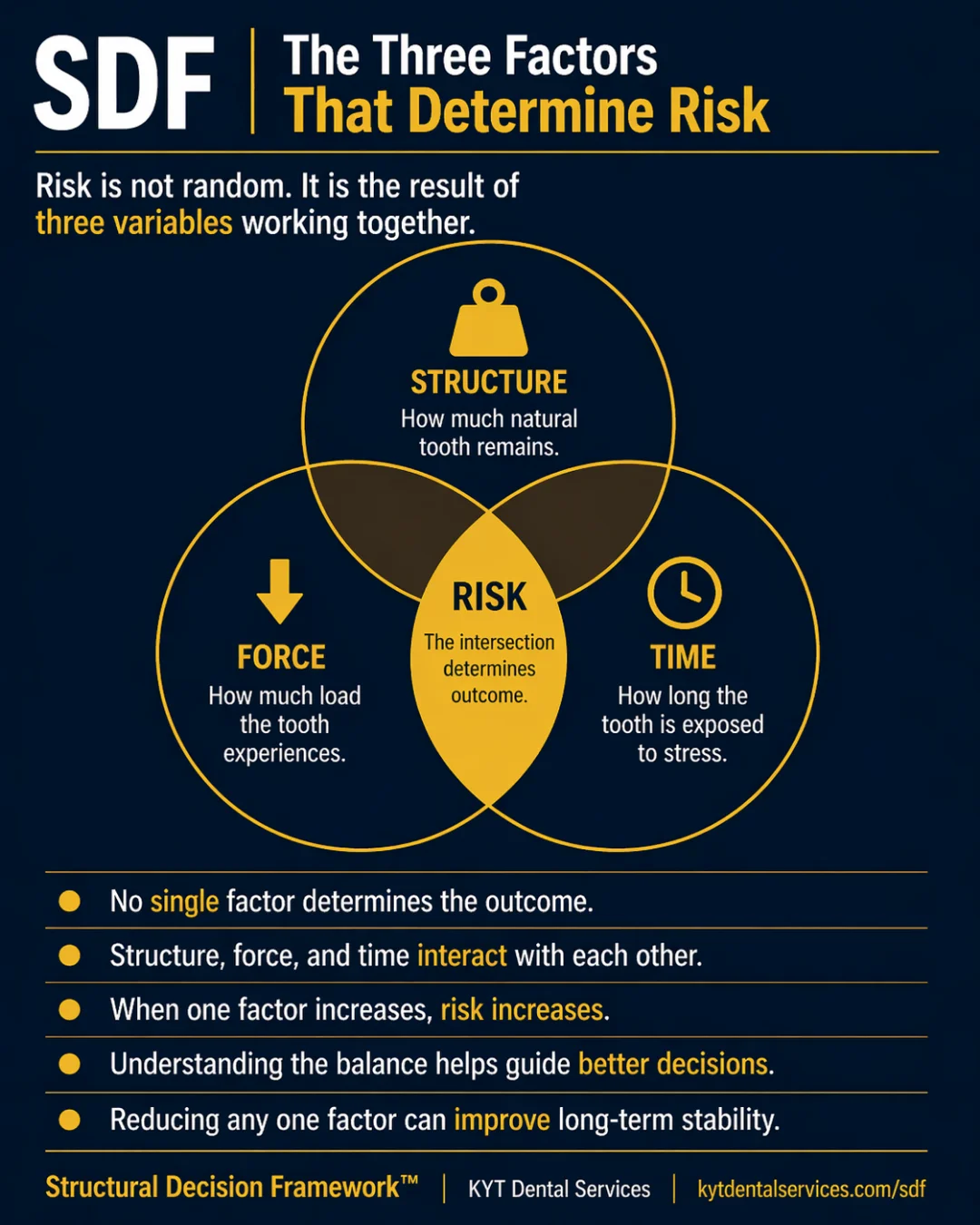
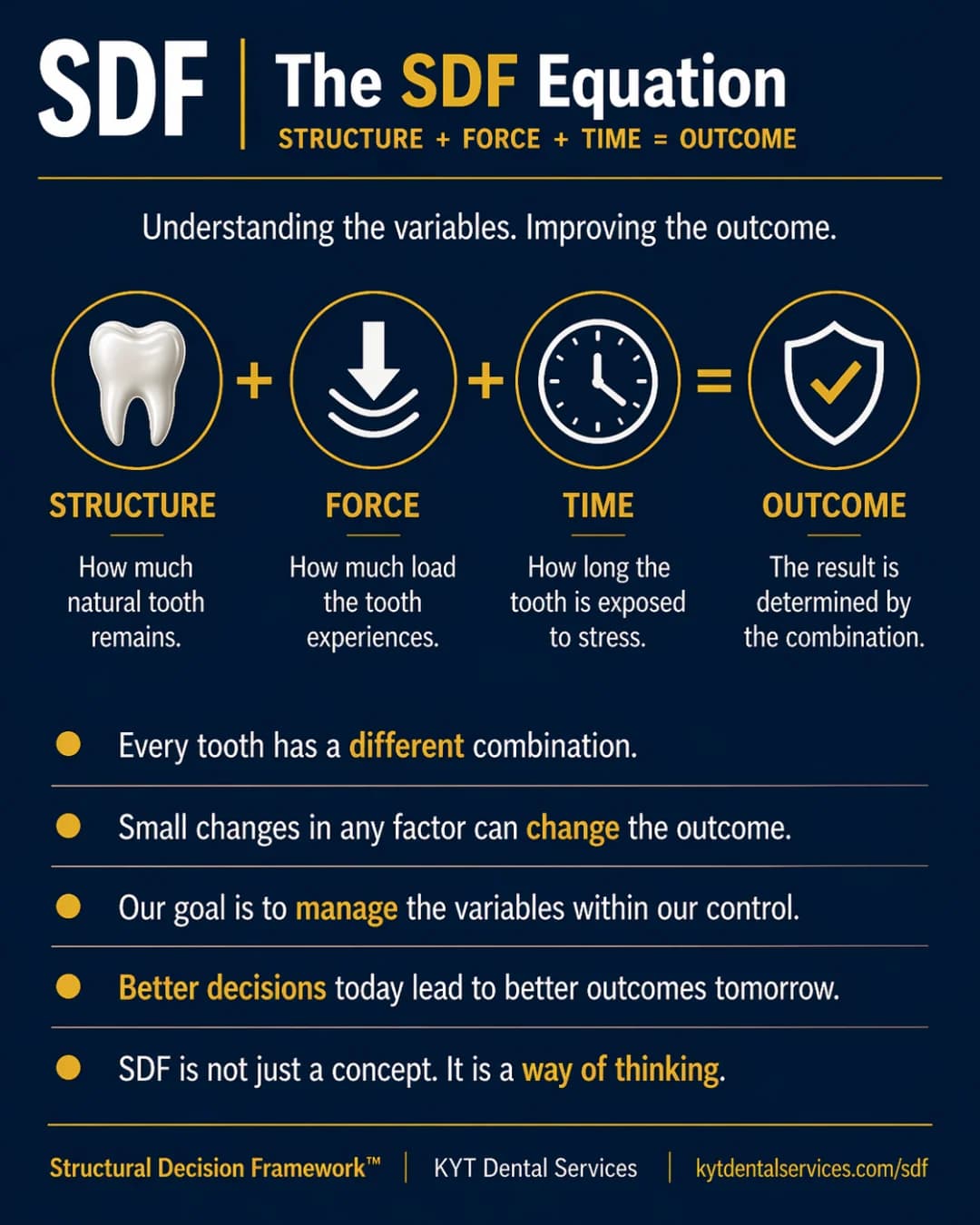
A tooth's stability isn't one thing. It's four, and they only work when they all work.
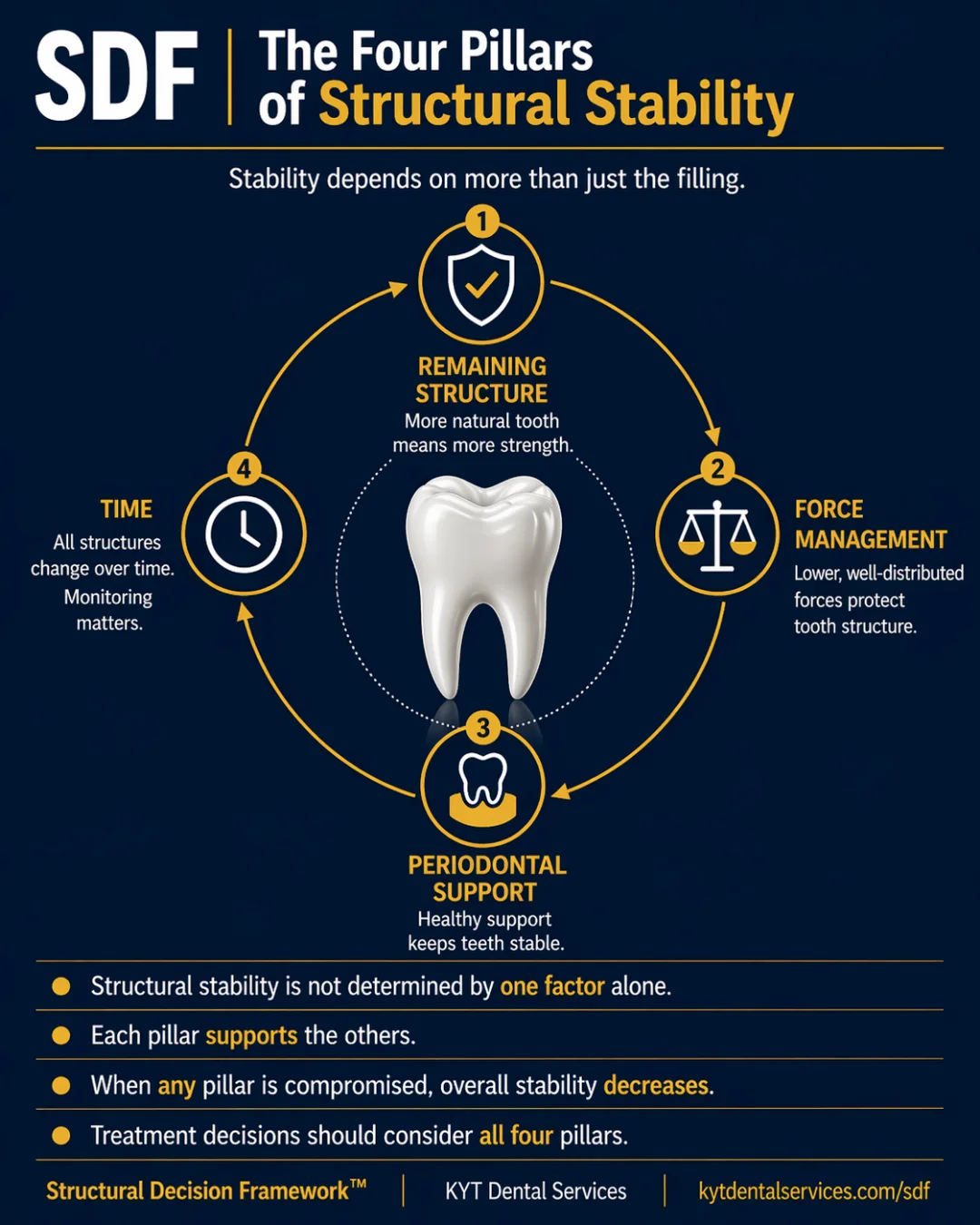
1. Remaining structure, how much natural tooth is left.
2. Force management, how the bite distributes load (grinding, clenching, uneven bite).
3. Periodontal support, the gums and bone holding the tooth in place.
4. Time, how all three of the above are changing year over year.
The weakest pillar decides how long the tooth lasts. Not the average. The weakest one. A tooth can be perfect on three of those pillars and dangerously low on the fourth, and the fourth is what limits the whole thing.
That's why "how does my tooth look?" is the wrong question. The right question is "which pillar is currently weakest, and what's the highest-leverage move to shore it up?" Sometimes that's a filling. Sometimes it's a nightguard. Sometimes it's deep cleaning around the gums. Sometimes it's just watching the trajectory at the next checkup. The treatment follows the weakest pillar, not the most visible problem.
The Lesson
One idea. One lesson.
Every idea in the Structural Decision Framework gets its own lesson. Hover to feel the foil.
SDF-08
StabilityThe Four Pillars of Structural Stability
A tooth's stability isn't one thing. It's four, and they only work when they all work.
↓ Open the model
Inside the Model
Read the diagram.
Through the Stability lens, every tooth is held up by four things at once: remaining structure, the way it handles force, the health of its foundation, and the slow change of all of them over time. The Four Pillars of Structural Stability is the card that names them and asks: which pillar is weakest right now, and what's the highest-leverage move to shore it up?
Fig. 08 · The Four Pillars of Structural Stability
SDF Framework
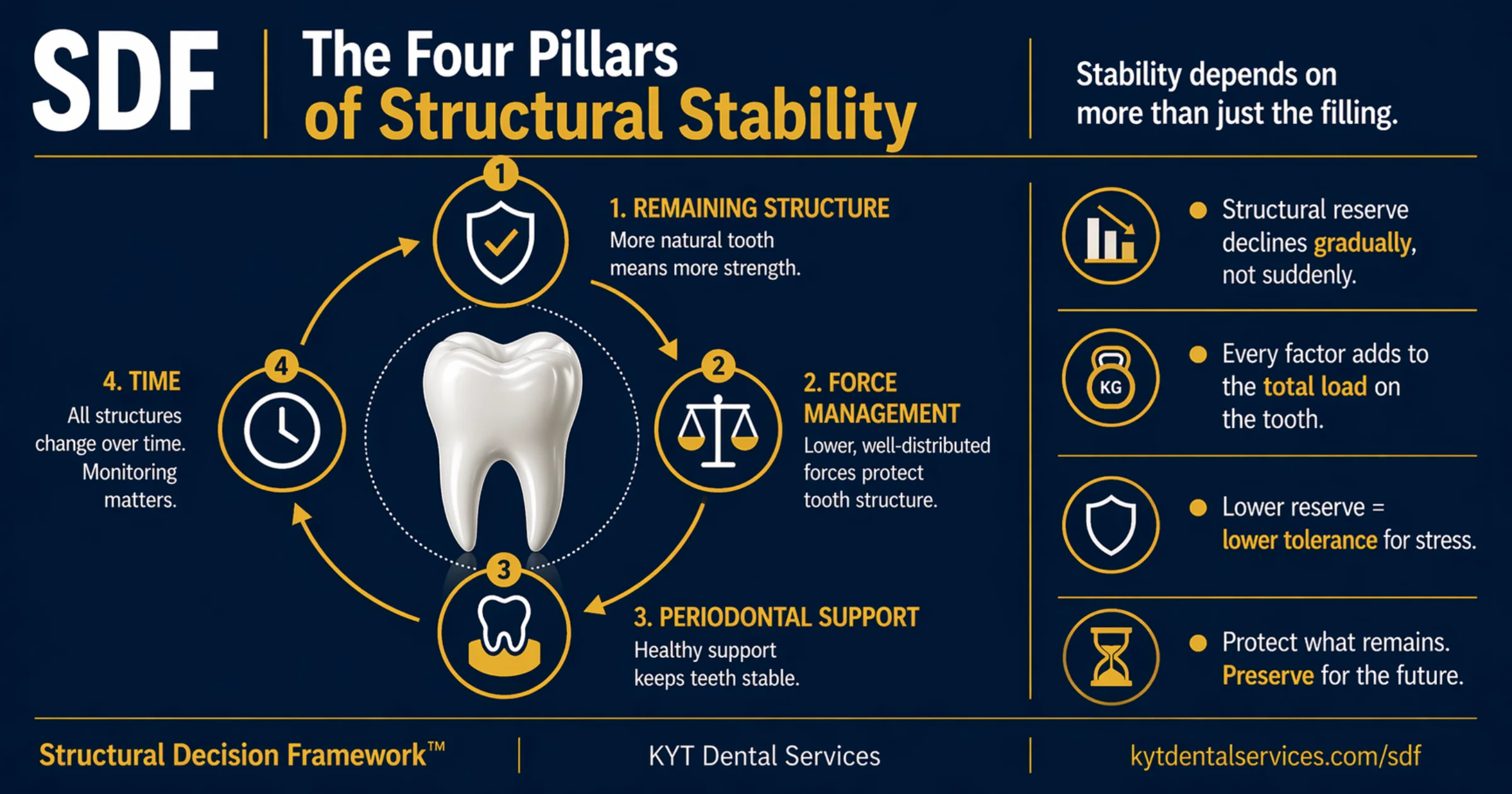
Tooth stability isn't about a single factor. It rests on four pillars working together: how much natural tooth is left, how forces are managed, how healthy the foundation is, and how the whole picture changes over time. A tooth is only as stable as its weakest pillar.
Explanation
When dentists talk about whether a tooth is stable, they're really asking four questions at once. How much natural tooth structure is left to do the work? How well are forces being distributed across the bite? How healthy are the gums and bone holding the tooth in place? And how is all of this changing year over year? A tooth can be strong on three pillars and dangerously low on the fourth, and the weakest pillar is what limits the whole thing. Stability is the score across all four, not the average.
Key takeaways
- Structural stability isn't decided by one factor, it's a balance of four.
- Each pillar supports the others. Strength in one can't fully cover weakness in another.
- When any single pillar is compromised, overall stability drops.
- The weakest pillar is the one that decides how long a tooth lasts.
- Smart treatment plans account for all four pillars, not just the obvious one.
In the chair
How it shows up.
01
The strong tooth on a weak foundation
A back tooth has no fillings, no decay, no cracks, by every measure, it looks intact. But years of gum disease have eroded the bone around it. The pillar that's failing isn't the tooth, it's the foundation. Saving this tooth means treating the gums, not the structure.
02
The well-built tooth with a force problem
A crown only a few years old, on a tooth that looks fine on every X-ray. But the patient grinds heavily, and the lateral forces are slowly stressing the cement and the root underneath. The compromised pillar here is force management. A nightguard at this stage can buy decades; ignoring it doesn't.
03
The slow drift
Annual checkups show one tooth shifting subtly each year. Nothing acute, nothing painful. But over a decade, the bite has moved enough that some teeth are now taking forces they weren't built for. Time is the pillar quietly destabilizing everything else, and the only way to catch it was to keep watching.
Through other lenses
The same idea, three other ways.
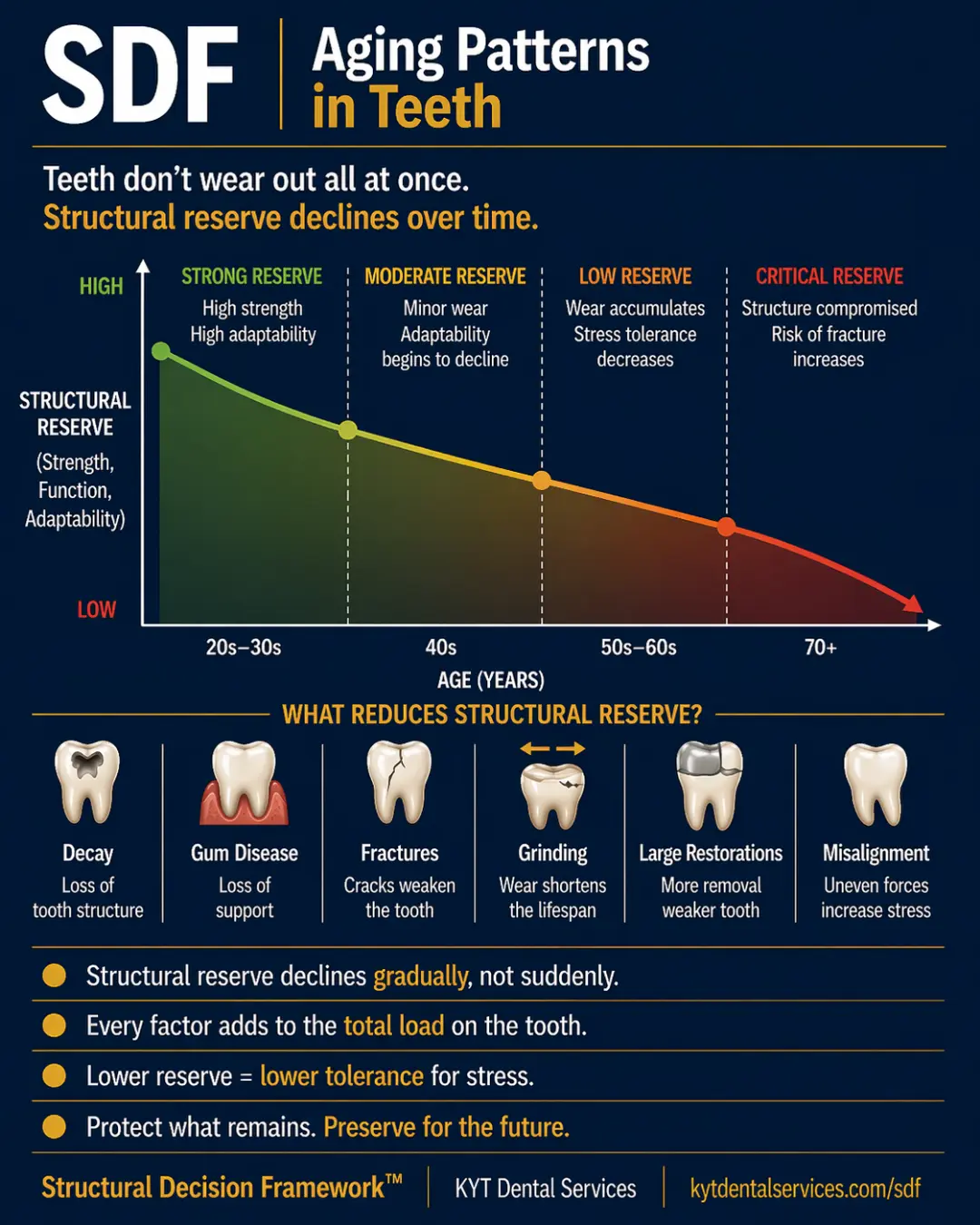
Remaining structure is the first pillar. The more natural tooth that's still there, the more reserve the tooth has against everything else the other pillars throw at it.
Force management is the second pillar. Even a tooth with high structural reserve can fail if forces are too high or unevenly distributed. Managing the load is part of managing stability.
Time is the fourth pillar, and it touches every other one. None of the pillars stay still. The only way to catch a falling pillar early is to keep watching, year after year.
Common questions
FAQ.
What are the four pillars?+
Remaining structure (how much natural tooth is left), force management (how the bite distributes load), periodontal support (the health of the gums and bone holding the tooth), and time (how all of these change year over year). Together, they decide how stable a tooth is.
If three pillars are strong, does that protect against the fourth being weak?+
Not really. Stability is set by the weakest pillar, not the strongest. A tooth with great structure and a great bite can still fail if the bone around it is gone, because nothing else can substitute for the foundation.
Which pillar matters most?+
It depends on the tooth. Most stable teeth are stable because no single pillar is dramatically below the others. Most failing teeth are failing because one pillar dropped off, and the rest couldn't compensate for long. The most important pillar in your mouth is whichever one is currently weakest.
Can a weak pillar be rebuilt?+
Sometimes. Structure can be partially rebuilt with crowns and fillings. Force can be reduced with nightguards or bite adjustments. Periodontal support can sometimes be stabilized or regrown. Time itself can't be reversed, but earlier monitoring catches drift before it becomes a problem.
How do I know which pillar is my weakest?+
Your dentist can tell from a combination of X-rays, gum measurements, bite analysis, and history. Most patients have one pillar that's clearly the limiting factor. Once you know which one, the most effective treatment is the one that strengthens it specifically, not a generic 'do everything' plan.
See this lesson in a real case
The story behind this lesson.
A patient case where this idea showed up in the chair.
See it in real teeth
From idea to actual cases.
This site explains the idea. The clinical version, with real cases, real X-rays, and what this looks like in actual mouths, lives at KYT Dental Services, the practice this framework comes from.
See it on KYT Dental Services →Keep going