The Cycle of Structural Deterioration
Lesson 07 · Structural Decision Framework
In plain English
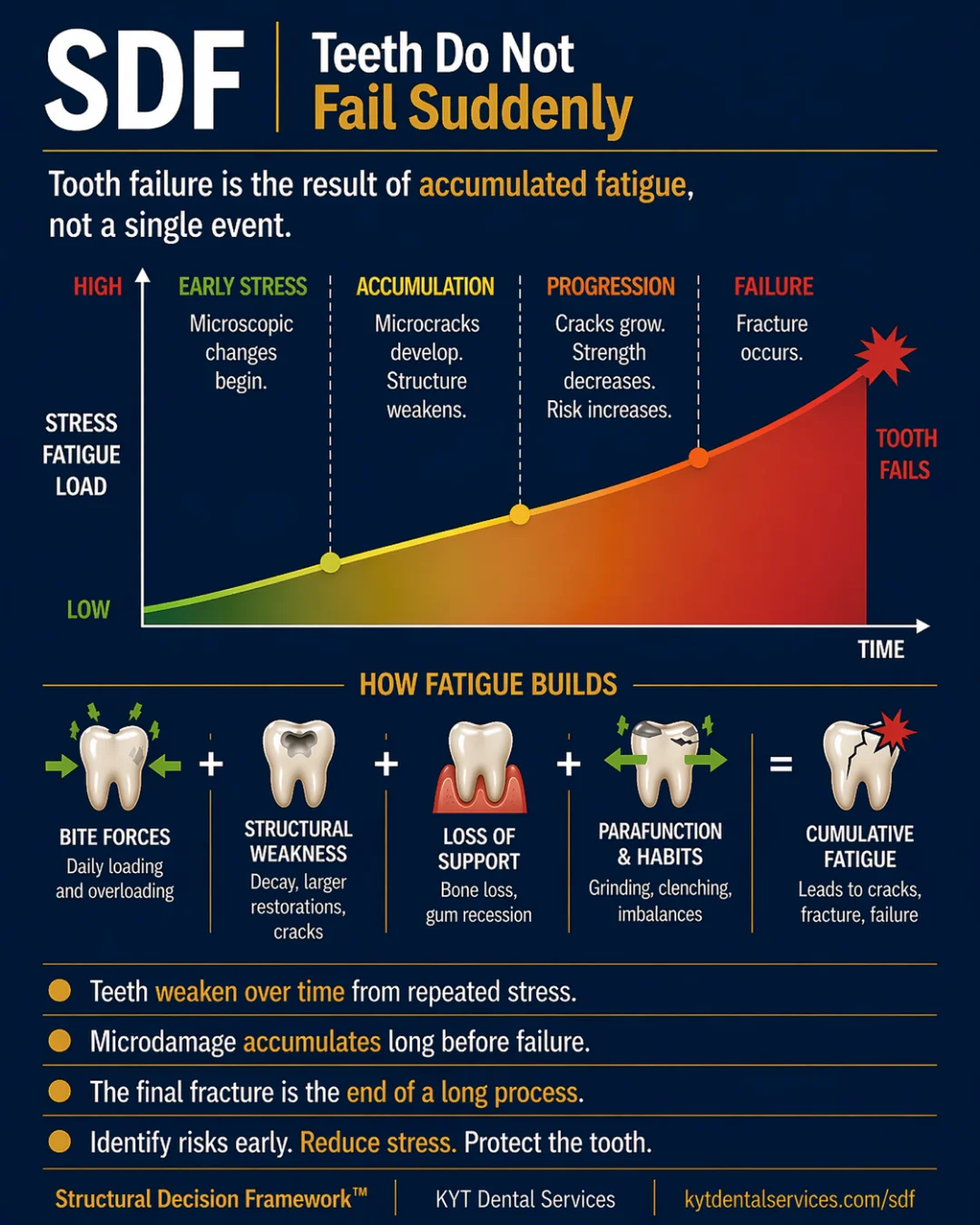
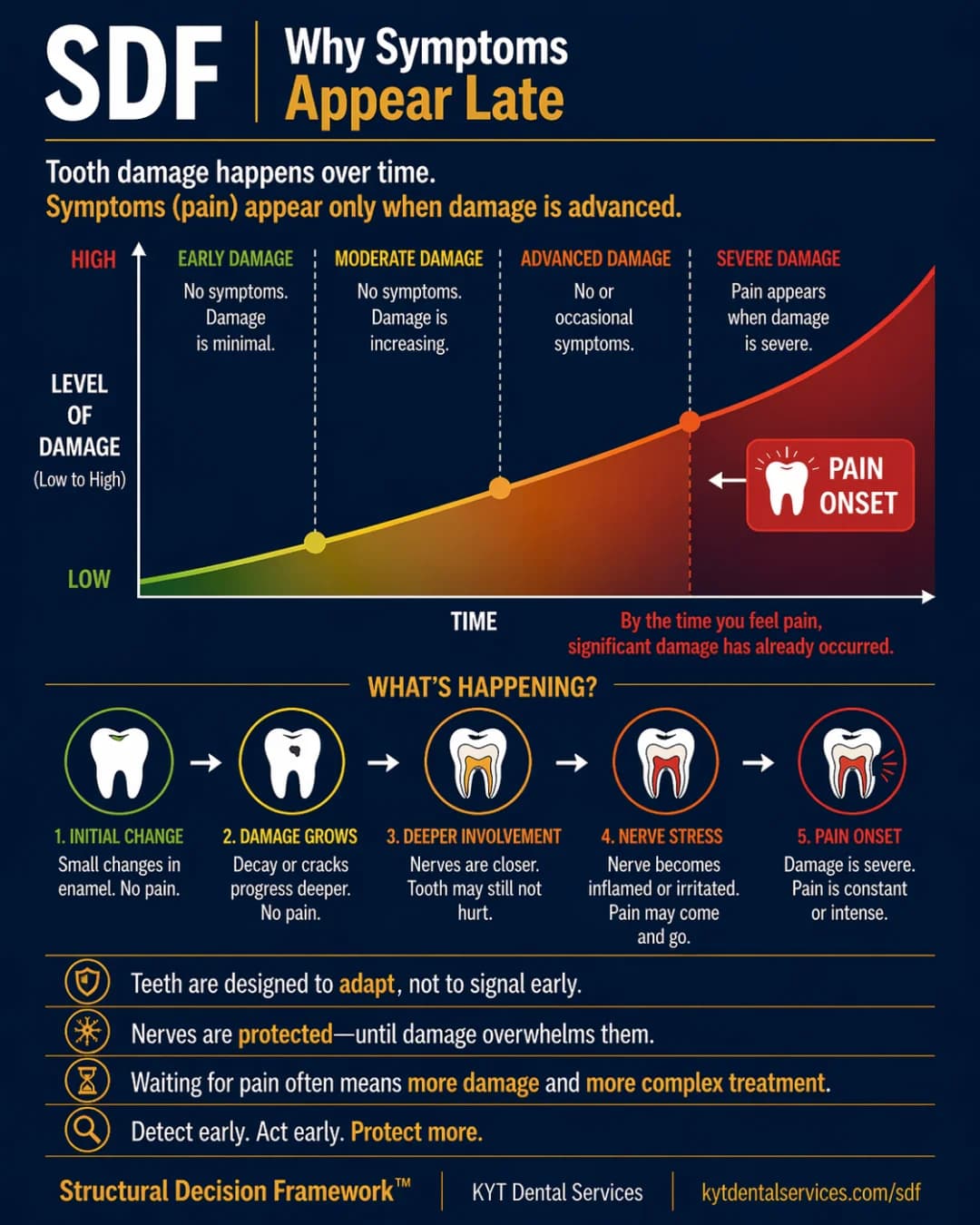
We see this all the time: a patient comes in for what they think is a routine cleaning, leaves needing a root canal.
Nothing changed for them between visits. They still brushed twice a day. Still flossed. Still had cleanings every six months. From the patient's perspective, the tooth was fine in January and broken in July.
What actually happened is that the tooth had been moving through a cycle for years, and the patient was only feeling the last stage.
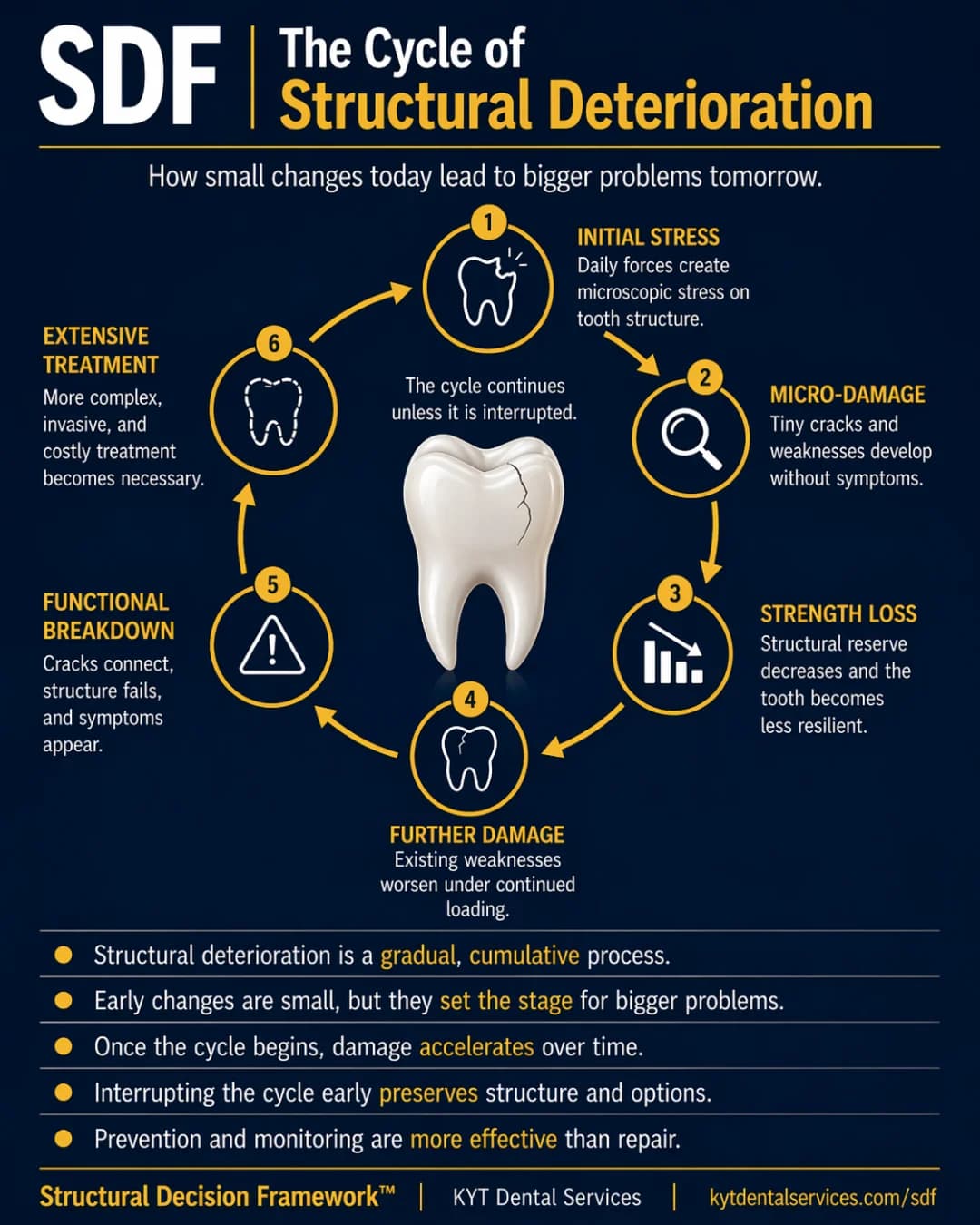
Tooth damage isn't a one-time event. It's a six-stage cycle:
1. Daily forces create microscopic stress.
2. The stress causes tiny cracks and weaknesses you can't see or feel.
3. Those weaknesses lower the tooth's structural reserve.
4. Lower reserve means the tooth tolerates less of the same daily load.
5. The cracks connect, symptoms show up, function starts to break down.
6. By that point, the only fix left is a big one, root canal, crown, sometimes extraction.
The cycle was running quietly the whole time. Pain just happened to be the last stage.
Here's the part most patients don't realize: the same patient could have caught this tooth at stage two with a small filling and a nightguard. Same tooth, very different procedure. The cycle hadn't changed. What changed was when it got caught.
This is why "come in even if nothing hurts" isn't a sales pitch. It's the only window where the cycle can be interrupted before it gets loud. The cheapest, smallest, most preserving fix is almost always available at stage one or two, and almost never at stage six.
The Lesson
One idea. One lesson.
Every idea in the Structural Decision Framework gets its own lesson. Hover to feel the foil.
SDF-07
TimeThe Cycle of Structural Deterioration
Tooth damage isn't a one-time event. It's a cycle, and each stage quietly sets up the next one.
↓ Open the model
Inside the Model
Read the diagram.
Through the Time lens, structural damage isn't a moment, it's a sequence. Every tooth is somewhere on the loop right now: stress, micro-damage, reserve loss, further damage, functional breakdown, extensive treatment. The Cycle of Structural Deterioration is the card that names the six stages and asks: where on the cycle is this tooth, and what would interrupt it earliest?
Fig. 07 · The Cycle of Structural Deterioration
SDF Framework
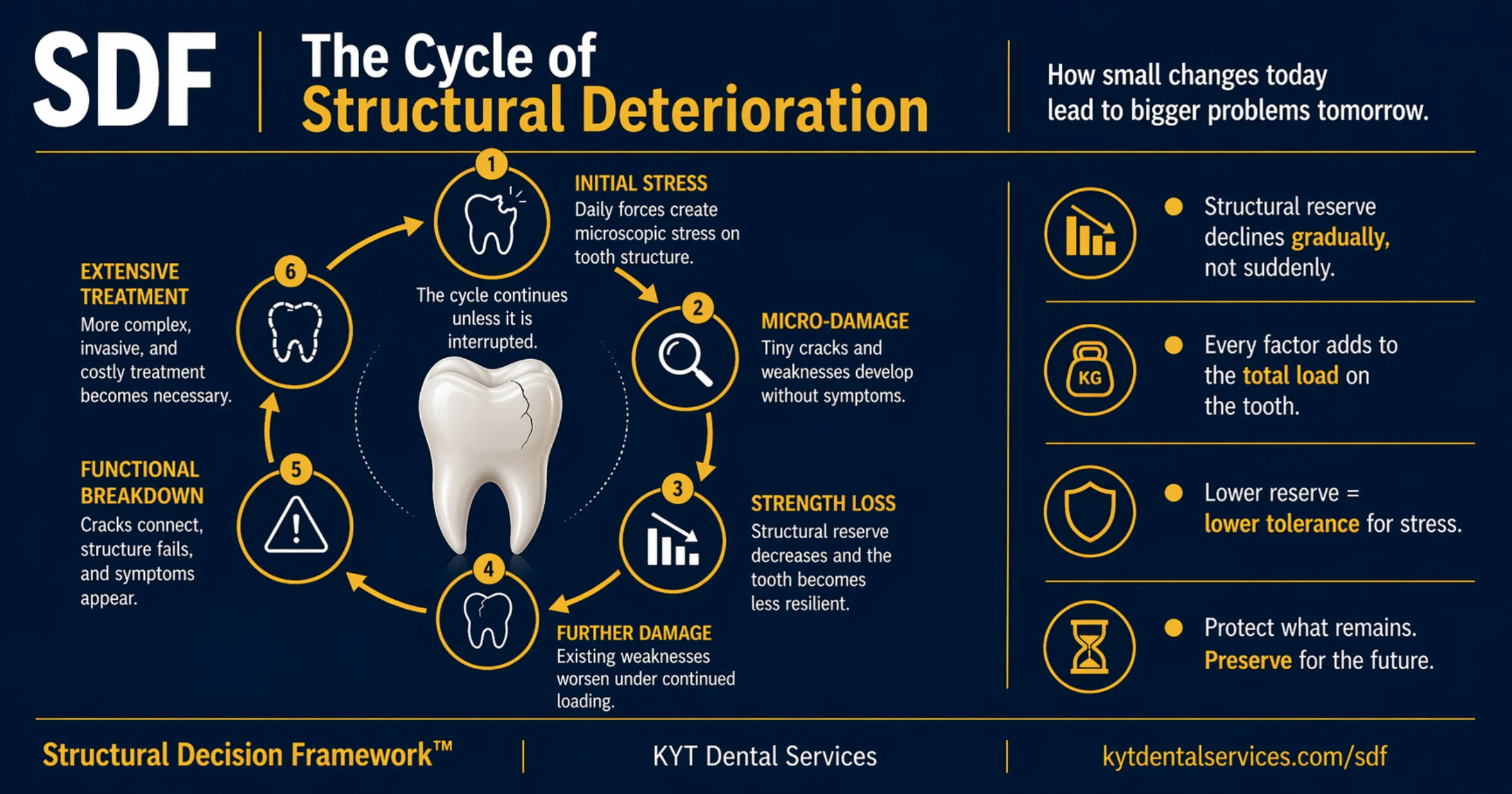
Tooth damage doesn't happen all at once. It builds in a cycle, six stages that turn microscopic stress into the kind of damage that needs a crown or a root canal. The earlier you interrupt the cycle, the smaller the fix.
Explanation
Most people picture tooth damage as a single event, a cavity, a chip, a crack. It's actually a slow loop. Daily forces create microscopic stress. The stress causes tiny cracks and weaknesses. Those weaknesses lower the tooth's structural reserve, which means it tolerates less of the same daily load. Reduced reserve makes the next round of damage easier. Eventually the small cracks connect, symptoms show up, and the only fix left is something invasive. The cycle was running quietly the whole time, pain just happened to be the last stage.
Key takeaways
- Structural deterioration is gradual and cumulative, the damage builds long before it shows.
- Early changes are small, but they set the stage for bigger problems.
- Once the cycle begins, damage tends to accelerate, not slow down.
- Interrupting the cycle early preserves both structure and options.
- Prevention and monitoring are far more effective than repair.
In the chair
How it shows up.
01
The tooth that's 'been fine for years'
No pain, no symptoms, no recent dental work. From the outside, nothing's happening. But on an X-ray, the tooth shows wear patterns and a small dark spot between two molars. The tooth is mid-cycle, somewhere around stage two or three. Catching it now means a small filling. Waiting until it hurts means catching it at stage five or six, when the options shrink fast.
02
The fracture that came out of nowhere
You bit into something soft and a back tooth split. It feels like a freak accident. It isn't. The tooth had been collecting micro-cracks under daily load for years, the bite that finally broke it was just the last one. The cycle had been running quietly the whole time; the fracture was stage five announcing itself.
03
The cleaning that interrupted the cycle
You came in for a routine checkup and your dentist pointed at an X-ray showing early wear and a tiny shadow that wasn't there last year. Nothing hurts. They recommend a small filling and a nightguard. Two interventions, both stage-one moves, and the cycle resets before it ever gets loud.
Through other lenses
The same idea, three other ways.
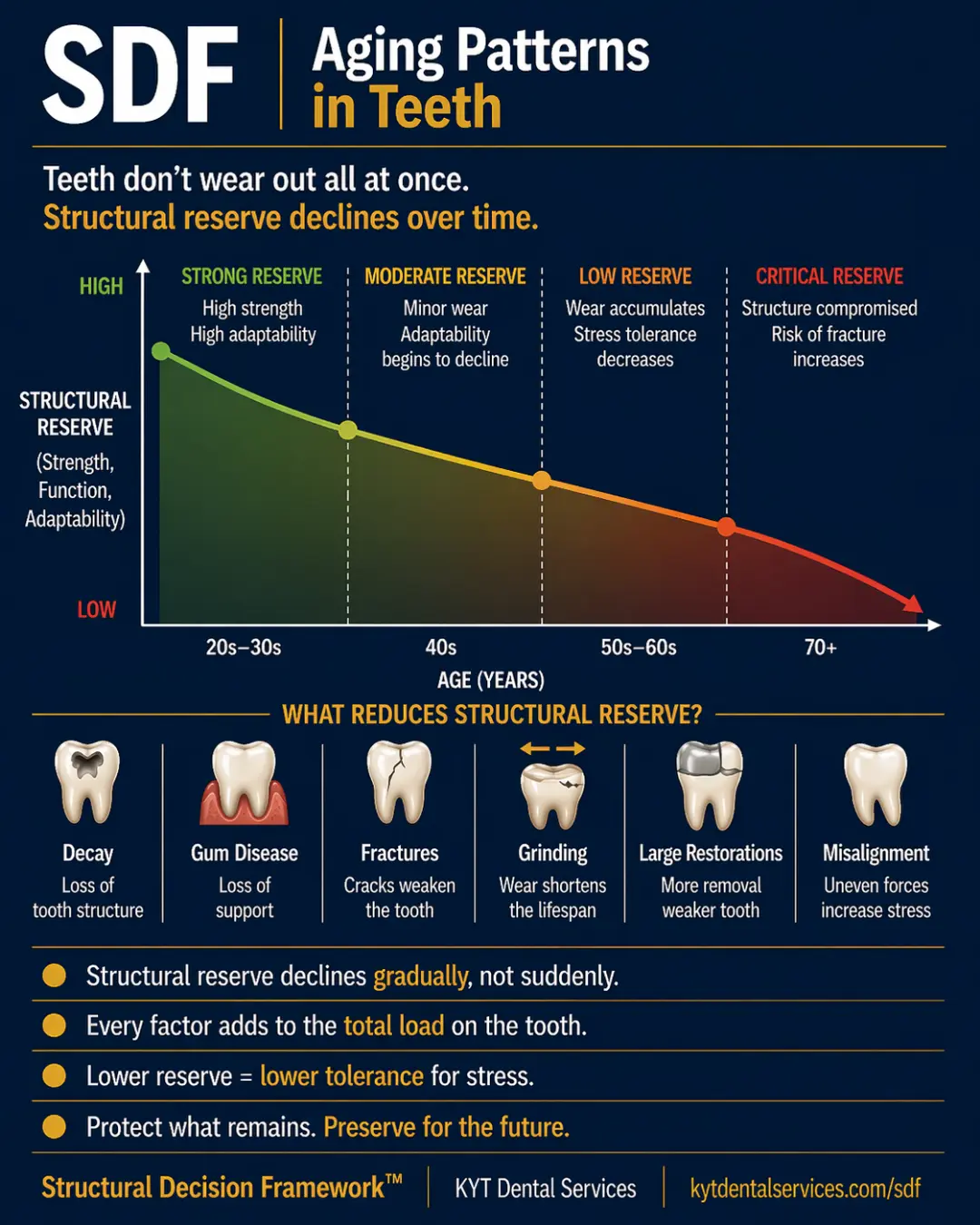
Each stage of the cycle takes a piece of structural reserve permanently. By the time you're at stage five or six, the natural tooth left to work with is much smaller than it was at stage one.
The cycle is force-driven. Bite, grinding, temperature, acid, and repetition are what move a tooth from one stage to the next. Reduce the loudest force and the cycle slows.
The most stable long-term outcomes come from interrupting the cycle as early as possible. The cheapest, smallest, most reversible fix is almost always the one available at stage one or two.
Common questions
FAQ.
What are the six stages of the cycle?+
Initial stress (daily forces create microscopic stress), micro-damage (tiny cracks form silently), strength loss (reserve drops), further damage (existing weaknesses worsen), functional breakdown (cracks connect and symptoms appear), and extensive treatment (the fix gets bigger and more invasive). Most teeth move through these slowly, over years.
If the cycle is silent, how do I know which stage I'm in?+
Your dentist can usually tell from a combination of X-rays, clinical exam, wear patterns, and bite analysis. The early stages are visible long before they're felt. If you're showing up regularly for cleanings, the silent stages are exactly what those visits are for.
Can the cycle be stopped or reversed?+
Stopped, yes. Fully reversed, no. Once structure is lost, it's gone. But the cycle can be interrupted at any stage, and interrupting it earlier means the tooth keeps more of its original strength and more of your future options stay open.
Why does damage accelerate in the later stages?+
Because lower reserve means less tolerance for the same daily forces. A 100% tooth absorbs a hard bite without flinching. A 40% tooth flexes more, cracks deepen faster, and the same bite that did nothing at stage one might do real damage at stage four. Each stage makes the next easier to reach.
What's the single best way to slow my own cycle?+
Catch problems early. Show up for regular checkups so the silent stages aren't silent to your dentist. Address grinding, acid exposure, and other recurring forces. The smallest, earliest fix is almost always the highest-leverage move you can make for a tooth's long-term future.
See this lesson in a real case
The story behind this lesson.
A patient case where this idea showed up in the chair.
See it in real teeth
From idea to actual cases.
This site explains the idea. The clinical version, with real cases, real X-rays, and what this looks like in actual mouths, lives at KYT Dental Services, the practice this framework comes from.
See it on KYT Dental Services →Keep going