Why Symptoms Appear Late
Lesson 05 · Structural Decision Framework
In plain English
We see this all the time: a patient calls in panic, a back tooth started hurting overnight on cold drinks, came out of nowhere, must be a new cavity.
When we look at the X-ray, the cavity has been growing in that tooth for at least 18 months. Possibly longer. The patient genuinely didn't feel anything until this week. The cavity isn't new, what's new is that the cavity finally got close enough to the nerve to wake it up.
Here's the part most people don't realize:
Pain is a late signal in dentistry. Maybe the latest signal. Your tooth's nerve is buried under layers of enamel and dentin specifically so that small damage doesn't reach it. That's a feature, you don't want to feel every chew. But it has a cost: by the time damage gets close enough to the nerve to actually hurt, it's almost always been progressing silently for months or years.
Cavities don't hurt while they're in enamel. They don't hurt while they're in most of the dentin. They start hurting when they're a millimeter or two from the nerve. By that point, the easy fix is usually behind you.
This is why dentists keep saying "come in for cleanings even if nothing hurts." It's not that we want to find more things to bill for. It's that the cheap-to-fix window for almost every dental problem is the silent one. The minute pain shows up, the menu of options shrinks fast, small filling becomes large filling becomes crown becomes root canal.
"It doesn't hurt" is not the same as "it's fine." In teeth, those almost never line up.
The Lesson
One idea. One lesson.
Every idea in the Structural Decision Framework gets its own lesson. Hover to feel the foil.
SDF-05
TimeWhy Symptoms Appear Late
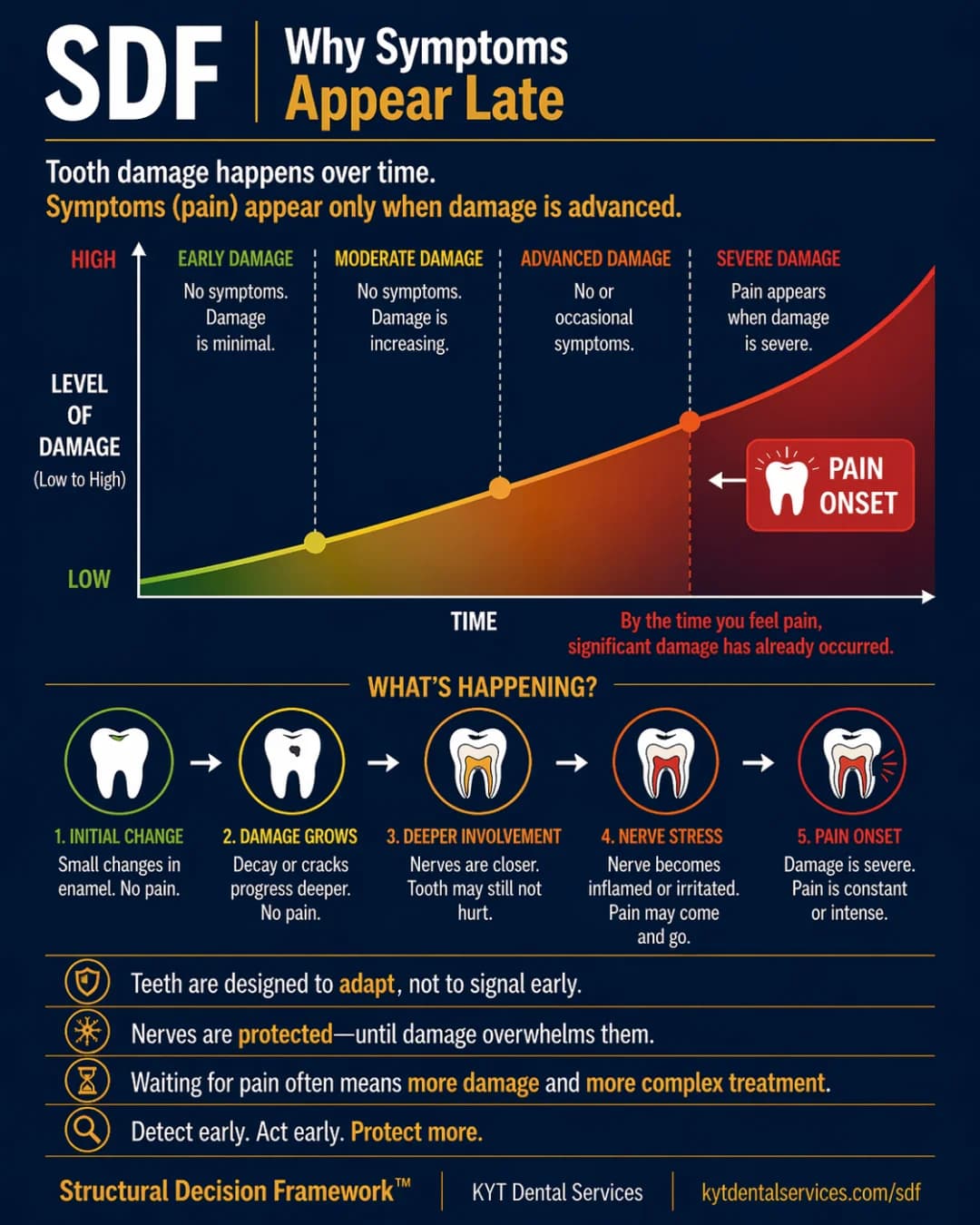
By the time a tooth hurts, the damage isn't starting, it's almost done.
↓ Open the model
Inside the Model
Read the diagram.
Through the Time lens, damage and pain are on different schedules. The damage starts the day enamel begins to wear or decay; the pain often shows up years later, after damage has reached the nerve. Why Symptoms Appear Late is the card that asks: where on the curve is this tooth, and are we treating the cause or just the alarm?
Fig. 05 · Why Symptoms Appear Late
SDF Framework
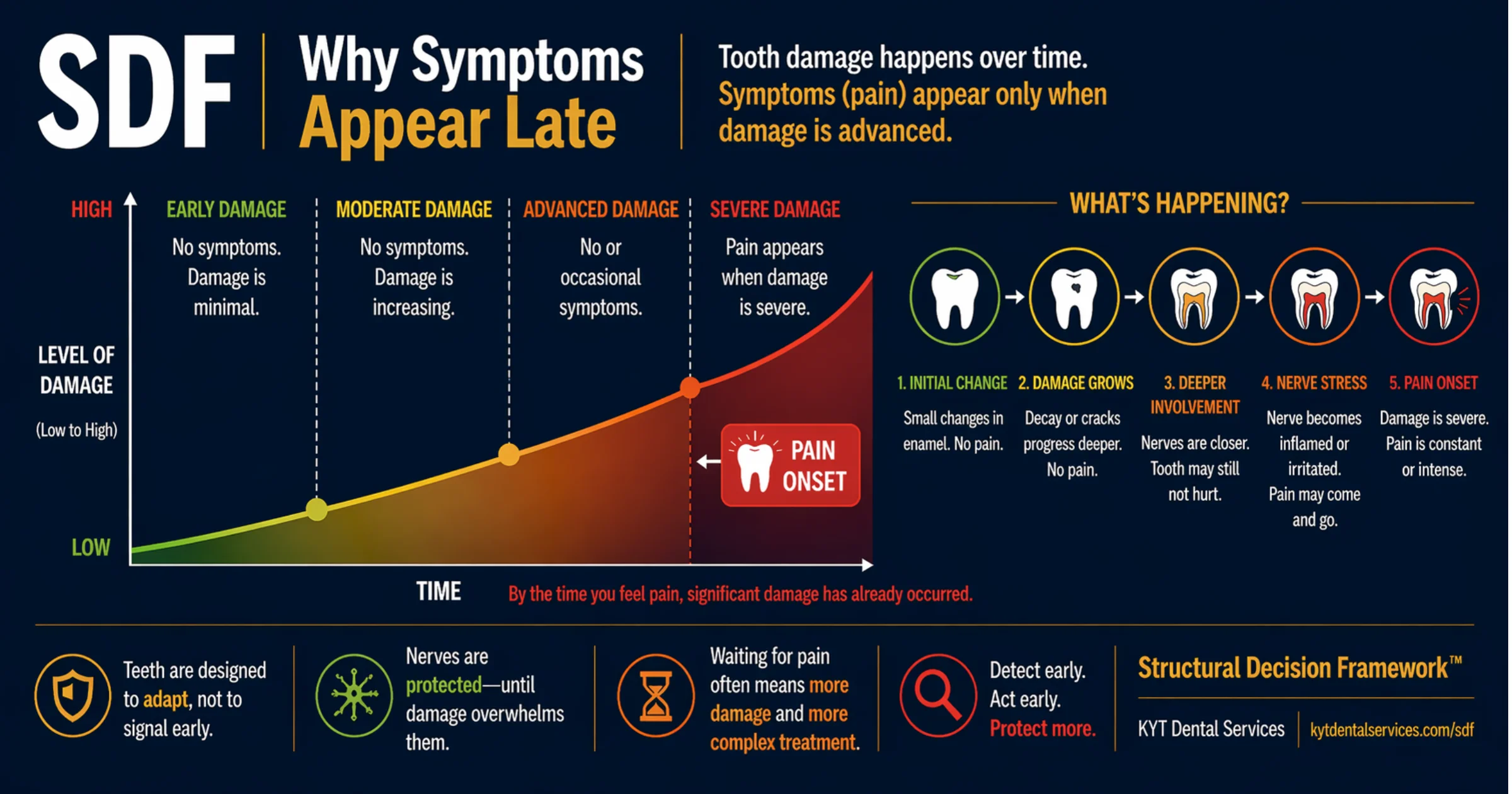
Pain is a late signal. Teeth go through four quiet stages of damage before they ever speak up, and once they do, the easiest fixes are usually behind you.
Explanation
Your tooth nerve sits behind layers of enamel and dentin that protect it from minor damage. Small changes in enamel, deeper decay, even cracks all happen silently because the nerve is still insulated. Pain only kicks in when damage gets close enough to inflame the nerve, by which point the structural problem has been brewing for months or years.
Key takeaways
- Pain is the body's late signal. Teeth are designed to adapt, not warn early.
- The nerve stays protected until damage gets close, which is usually past the easy fix.
- Waiting until it hurts almost always means more damage and a bigger treatment.
- The earliest signs are visible on X-rays and exams long before they're felt.
In the chair
How it shows up.
01
The cavity that hurt out of nowhere
You felt fine for years. Then one cold sip and a sharp pain. Your dentist shows you the X-ray, the cavity has been growing for at least 18 months. The pain didn't appear because the cavity is new. It appeared because the cavity finally got close enough to the nerve.
02
The cracked tooth that comes and goes
Some days a tooth hurts to chew on. Other days it's fine. The crack has been there for a while, and your nerve is occasionally getting irritated when forces flex it open. This stage, pain that comes and goes, is the warning before the bigger break. Acting now is much cheaper than acting after the fracture.
03
The cleaning that found something silent
You went in for a routine checkup with no complaints. Your dentist points at an X-ray and says you have a cavity between two back teeth. You're surprised, nothing hurts. That's not unusual; it's the normal pattern. Catching it now means a small filling instead of a crown.
Through other lenses
The same idea, three other ways.
Pain shows up when structure has already been compromised. The deeper the layer affected (enamel → dentin → pulp), the louder the signal, but also the bigger the structural damage to fix.
Forces that cause cracks and wear are silent until they reach a sensitive layer. The grinding that wore your enamel for years didn't tell you it was happening.
The most stable long-term outcomes come from acting before pain. A small problem caught early stays small. The same problem caught late often becomes a chain of bigger problems.
Common questions
FAQ.
If it doesn't hurt, isn't my tooth fine?+
Not necessarily. Most early dental damage is silent because the nerve is still protected. By the time a tooth hurts, the damage has usually been progressing for a while. 'No pain' just means 'damage hasn't reached the nerve yet', not 'no damage.'
Why don't I feel cavities sooner?+
Because the cavity is in enamel and dentin, which don't have nerves. Pain only starts when the cavity gets close to or reaches the pulp. That's usually months to years into the cavity's life, depending on how aggressively it's growing.
If I do feel pain, is it always serious?+
Tooth pain is almost always a sign of advanced damage. Sensitivity that comes and goes might be reversible. Constant pain or pain on chewing usually means the nerve is irritated or infected. Either way, it's a signal that the easy-window is closing.
What can a dentist see that I can't?+
X-rays show cavities, cracks, and bone changes long before they're felt. A clinical exam shows wear patterns, gum recession, and the early stages of damage. Most catastrophic problems were visible to a dentist a year or more before they hurt.
How often should I get checked if I have no symptoms?+
Twice a year for most people, more often if you're at higher risk for decay, cracks, or gum disease. The whole point of regular checkups is to catch the silent stages, because those are the cheap-to-fix windows.
See this lesson in a real case
Stories behind this lesson.
Patient cases where this idea showed up in the chair.
See it in real teeth
From idea to actual cases.
This site explains the idea. The clinical version, with real cases, real X-rays, and what this looks like in actual mouths, lives at KYT Dental Services, the practice this framework comes from.
See it on KYT Dental Services →Keep going